ISTANBUL, TÜRKİYE — Great design rarely begins with a grand marketing rollout or a venture-backed product launch. More often, it emerges organically out of necessity, born from the persistent repetition of a specific aesthetic thread. Such is the origin story of Regen Studio, a Türkiye-based design practice and bespoke furniture brand that has been quietly redefining the intersection of spatial architecture and collectible craft.
Far from being conceived in a boardroom, Regen Studio started as a subconscious pattern. For years, its founder—a trained architect—found herself repeatedly designing custom furniture and spatial elements to solve hyper-specific problems within individual architectural commissions. Over time, a distinct continuity began to emerge across these disparate projects. Whether it was a built-in seating arrangement, a custom table, or a transitional room divider, the same underlying sensibility kept surfacing: a shared language of proportion, material honesty, and atmospheric resonance.
Eventually, ignoring that continuity became impossible. Regen Studio was born out of the deliberate decision to give that unprompted design language an independent name, a physical structure, and the freedom to evolve beyond the constraints of standard architectural client briefs. Today, the studio operates as a boutique practice rooted entirely in traditional handcraft, producing strictly made-to-order furniture that rejects mass manufacturing in favor of true collectibility.
1. Main Facts: The Anatomy of Regen Studio
At its core, Regen Studio functions as a bridge between the structural rigor of architecture and the intimate, tactile world of bespoke furniture. Operating out of Türkiye, the brand collaborates closely with a tight-knit network of skilled local artisans, ensuring that nothing is ever produced at scale. Each item is crafted individually, making every piece of furniture a unique artifact designed to last for generations.
Founding Philosophy: Furniture is treated as an extension of architecture. Spatial relationships, structural proportion, and atmospheric weight guide the design process from conception to completion.
Production Model: 100% made-to-order, handcrafted by local artisans in Türkiye with a standard delivery window of 2 to 4 weeks.
Materiality & Aesthetic: A thoughtful blend of mid-century modern organic forms, structural clarity, and revived historical techniques, translated through contemporary finishes like root veneer and bold lacquers.
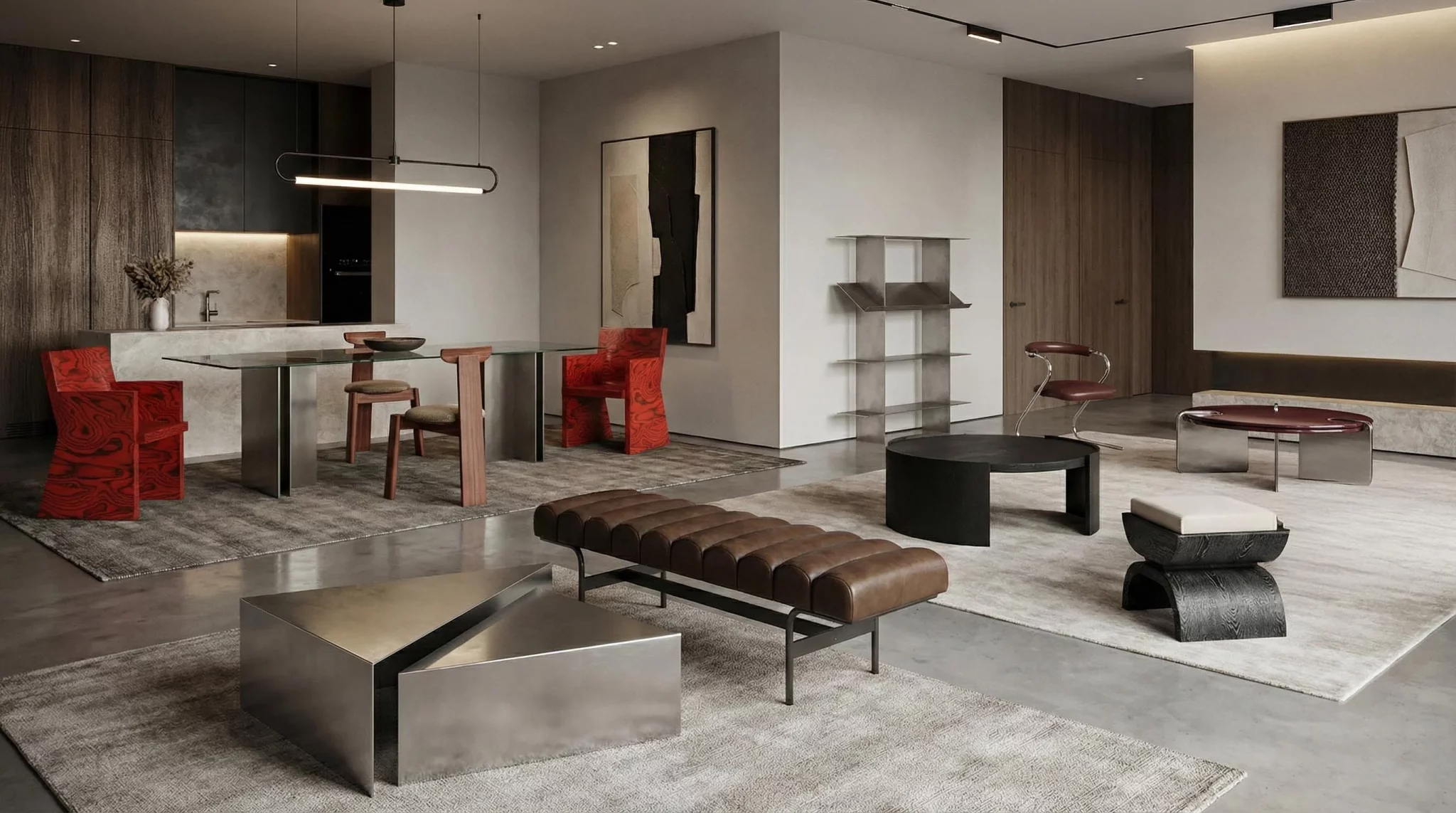
Signature Piece: The Kira Chair—a sculptural statement piece featuring a root veneer surface, a bold red polish, and precise architectural proportions (88 × 56 × 63 cm).
2. Chronology: The Evolution from Spatial Problem-Solving to Brand Identity
To understand how Regen Studio arrived at its current iteration, one must trace the timeline of its architectural origins.
Phase I: The Architectural Practice (The Incubation Years)
Long before Regen Studio existed as a standalone brand, the founder was deeply entrenched in traditional architectural practice. Day-to-day work involved designing residential and commercial spaces, which frequently required bespoke elements to fit awkward corners, unconventional layouts, or precise client demands. Instead of sourcing off-the-shelf furniture that compromised the spatial integrity of these interiors, the practice began designing custom furniture pieces from scratch.
Phase II: The Emergence of a Shared Logic
As years progressed, a common thread began binding these custom pieces together. Even when created for entirely different clients and spatial typologies, the furniture shared a distinct worldview. The proportions mirrored one another; the choice of materials leaned toward tactile warmth and structural integrity; the atmospheric impact on a room remained consistently grounded yet elevated. The designer realized that these objects were no longer merely servicing individual rooms—they were forming an independent vocabulary.
Phase III: Liberation from the Client Brief
The turning point came when the desire to pursue this design language outweighed the confines of traditional client-service architecture. Regen Studio was established to strip away outside briefs, allowing the founder to explore form, material, and function on her own terms. The studio became a vehicle for pure design experimentation, where constraints—ranging from spatial limitations to material availability—were reframed as creative catalysts rather than obstacles.
Phase IV: Craftsmanship and Contemporary Collectibility
Today, Regen Studio stands as a fully realized furniture brand and design practice. By partnering exclusively with master artisans in Türkiye, the studio has solidified its production model around slow design and uncompromising quality. The recent spotlight on foundational pieces, such as the Kira Chair, signals the brand’s transition from an insider secret within architectural circles to a globally recognized name in collectible design.
3. Supporting Data & Design Philosophy
Regen Studio’s methodology relies on a meticulous synthesis of historical reverence and contemporary execution. The studio draws heavily from the principles of mid-century modern design—celebrating organic forms, functional clarity, and the timeless application of raw materials. However, the studio’s creative director is equally fascinated by forgotten artisanal techniques and sidelined materials, resurrecting them not out of mere nostalgia, but through a modern interpretive lens.
+------------------------------------------------------------+
                 REGEN STUDIO DESIGN PIPELINE
+------------------------------------------------------------+
 1. Context & Space Analysis  --> How the object lives in a room
 2. Architectural Proportions --> Scale, function, and balance
 3. Material Exploration      --> Root veneer, metal, and texture
 4. Iterative Workshop Making --> Hands-on refinement with artisans
+------------------------------------------------------------+
Every creation begins by evaluating context: How will this object inhabit a space? What psychological or atmospheric tone should it introduce? Architectural thinking dictates the initial phase, focusing heavily on scale, proportion, and structural function. Only once the spatial geometry is locked does the studio dive into material exploration—testing textures, finishes, and color combinations to ensure each object possesses both physical presence and visual subtlety.
The manufacturing process is deeply iterative. Sketches are translated into physical prototypes, refined through back-and-forth communication with the workshop, and adjusted until the object achieves visual and emotional equilibrium. Craftsmanship is integrated from day one, meaning the physical capabilities of the artisan directly influence the final character of the piece.
Furthermore, Regen Studio embraces constraints. Many of the brand’s most innovative silhouettes were initially born under the duress of strict architectural timelines, spatial restrictions, or raw material scarcity. Rather than diluting the design, these limitations forced a level of precision and resourcefulness that now defines the studio’s signature aesthetic.
4. Official Statements and Studio Insights
In reflections on the brand’s philosophy, the founder emphasizes that furniture should never be viewed as an isolated object, but rather as an active participant in an interior ecosystem.
"Furniture is not separate from architecture—it is an extension of the same thinking," notes the studio’s founder. "Proportion, spatial relationships, and the way an object holds or releases the atmosphere of a room are architectural questions. We simply answer them in wood, metal, color, and texture."
This sentiment is physically manifested in pieces like the Kira Chair. Measuring 88 × 56 × 63 cm, the chair was conceived with architectural dimensions in mind—built for a specific room rather than optimized for flat-pack shipping or mass-market catalogues. Featuring a striking root veneer surface coated in a bold red polish, the Kira Chair cuts a confident silhouette without shouting for attention.
"It is a chair that quietly shapes the atmosphere around it," the studio describes. "It doesn’t announce itself; it simply refuses to be ignored. Ultimately, it becomes a mirror of the person who lives with it."
5. Implications for the Future of Collectible Design
The rise of Regen Studio highlights a broader, much-needed shift within the contemporary design landscape. As consumers and interior designers increasingly suffer from fatigue brought on by fast-furniture cycles and hyper-globalized homogenization, studios that champion localized handcraft, architectural lineage, and true collectibility are stepping into the spotlight.
By keeping production intentionally small and localized in Türkiye, Regen Studio bypasses the environmental and cultural pitfalls of mass-market manufacturing. The implications of this model are significant:
Revitalization of Local Craft: By maintaining steady partnerships with regional artisans, studios like Regen help preserve traditional woodworking and finishing techniques that might otherwise vanish in a digital economy.
The Blur Between Art and Utility: As furniture continues to be acquired not just for utilitarian function but as collectible art, pieces engineered with architectural discipline offer buyers a deeper, more permanent connection to their living spaces.
Slow Design as a Standard: The 2-to-4-week made-to-order window reminds the market that patience is an essential component of quality, pushing back against the instant-gratification culture of modern retail.
As Regen Studio continues to expand its catalog—anchored by statement-making works like the Kira Chair and driven by an unwavering architectural framework—it offers a compelling blueprint for the future of independent design: one where context dictates creation, constraints breed innovation, and every single object tells a deliberate, unhurried story.