









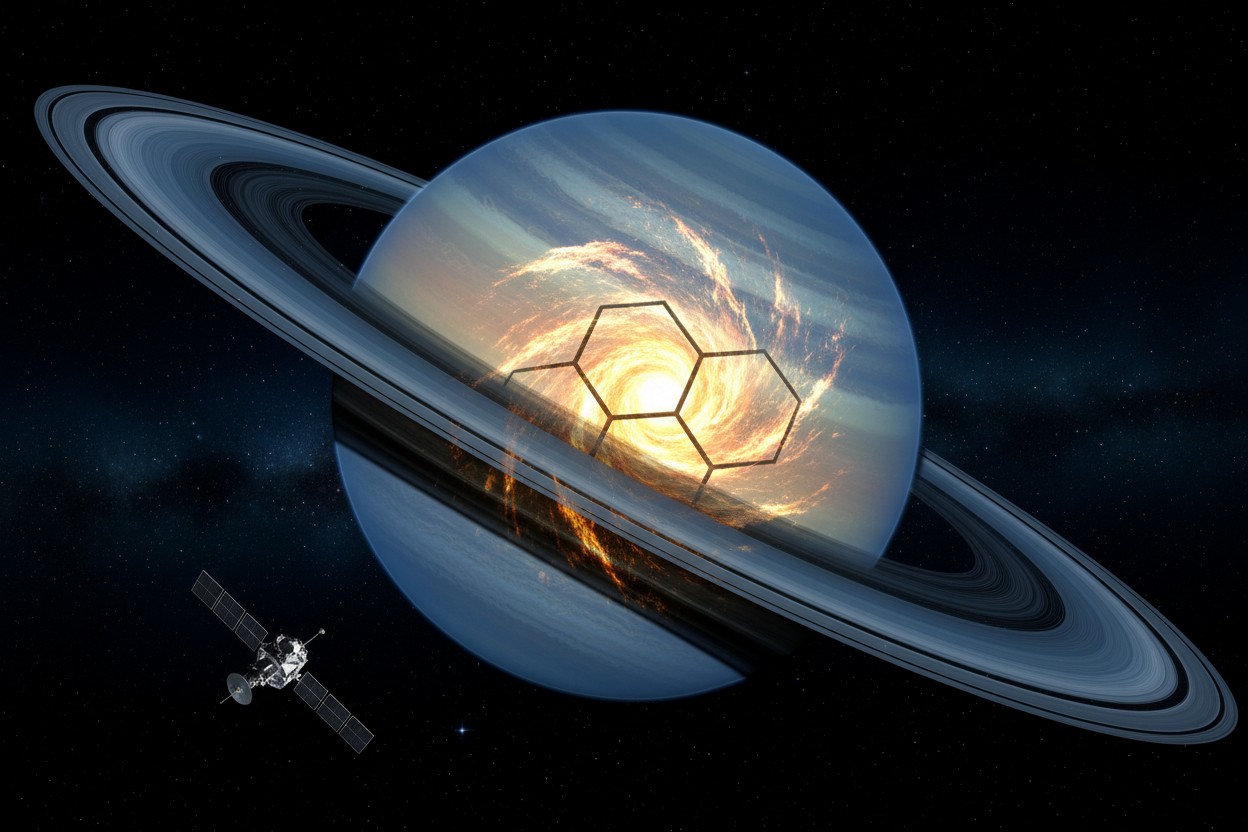
WASHINGTON — In a landmark planetary discovery that is upending decades of meteorological models, NASA’s Hubble Space Telescope has detected a massive, evolving, 10-sided atmospheric wave circling Saturn’s south pole. The finding, detailed in a study published on September 3, 2026, in the journal Science Advances, marks the first time astronomers have ever observed a large, regularly shaped polygonal jet pattern within the ringed gas giant’s southern hemisphere.
Dubbed a "decagon" by the research team, this newly uncovered atmospheric formation bears striking, albeit mysterious, resemblances to Saturn’s famous and long-studied northern hexagon—a persistent six-sided jet stream that has baffled scientists for over forty years. However, unlike its permanent northern counterpart, the southern decagon appears to be a brand-new, actively developing phenomenon. By combining sharp space-based imaging with amateur ground-based contributions, researchers have captured a rare, real-time look at how gargantuan planetary wave structures are born, strengthen, and evolve.
Main Facts: Anatomy of the Saturnian Decagon
The newly identified decagon is not merely a superficial cloud-top pattern; it is a profound, vertically integrated atmospheric wave embedded deep within one of Saturn’s powerful southern jet streams.
- The Shape: True to its name, the wave features ten distinct, regularly spaced sides wrapping continuously around the planet’s polar region.
- Vertical Extent: Data captured across various wavelengths by Hubble reveal that the decagon extends through multiple layers of Saturn’s atmosphere. When observed at different altitudes via specific filters, the feature exhibits slight shifts in its apparent geographical placement, confirming its three-dimensional structure.
- Dynamic Evolution: Unlike the static stability of the northern hexagon—which was documented by NASA’s Voyager and Cassini missions—the southern decagon is actively changing. Archival data analyzed through NASA’s Outer Planet Atmospheres Legacy (OPAL) program shows that the structure has been steadily strengthening since it was first confirmed in 2023.
- The Research Team: The international study was led by planetary scientist Agustín Sánchez-Lavega of the University of the Basque Country in Spain. Co-authors include Amy Simon, senior planetary scientist at NASA’s Goddard Space Flight Center and principal investigator for the OPAL program, and Michael Wong of the University of California, Berkeley.
Chronology of Discovery: From Backyard Telescopes to Space-Based Confirmation
The path to discovering Saturn’s southern decagon is a triumph of modern collaborative science, bridging the gap between dedicated amateur astronomers and premier space agencies.
The Amateur Spark (2024)
The story began not in a high-tech control room, but in the backyards of passionate amateur astronomers. In 2024, planetary observers Trevor Barry and Jean-Paul Oger captured faint, unusual wavy banding near Saturn’s southern pole. They submitted these images to professional observation laboratories, catching the attention of Agustín Sánchez-Lavega and his research team. Reviewing the data, the scientists realized they were looking at the early, faint signatures of an organized wave pattern.
Ground-Based Verification (2025)
Building on the amateur leads, professional ground-based observatories targeted Saturn throughout 2025. The resulting images provided much stronger evidence that the wavy band had condensed and organized into a distinct, multi-sided geometric structure. Recognizing the significance of the anomaly, the team petitioned for time on the Hubble Space Telescope to cut through Earth’s atmospheric distortion and acquire high-resolution imagery.
Retrospective Data Mining (2023–Present)
Once Hubble trained its sensitive optics on Saturn, researchers dug into historical archives maintained by the OPAL program, which has systematically photographed the outer planets on an annual basis for over a decade. To the team’s surprise, Hubble’s sharp, unobstructed vision confirmed that faint traces of the decagon had actually been present in OPAL images dating back to 2023. This retrospective data collection provided scientists with a complete timeline of the wave’s intensification, transforming an isolated discovery into a longitudinal study of planetary meteorology.
Supporting Data and Comparative Analysis: North Versus South
The discovery of a southern polygonal wave immediately invites comparisons to Saturn’s iconic northern hexagon. For decades, the north polar hexagon stood as a singular oddity in the solar system—a stable, continent-sized six-sided jet stream persisting through decades of seasonal changes, successfully imaged by Voyager 1 and 2 in the 1980s and later studied extensively by the Cassini spacecraft from 2004 to 2017.
Planetary scientists had long searched for a southern counterpart to balance the planet’s global meteorology. However, data returned by Cassini showed no indication of a long-lived southern polygon during its 13-year orbital mission, leading many to believe that Saturn’s poles were fundamentally asymmetrical.
The detection of the decagon shatters that assumption, yet crucial differences separate the two polar phenomena:
- Symmetry and Sides: The northern feature is a hexagon (six sides), while the southern counterpart is a decagon (ten sides). The reasons behind the specific choice of wave numbers (6 versus 10) remain completely unknown to fluid dynamicists.
- Stability and Age: The northern hexagon is a generational fixture, appearing unchanged for over 40 years. In contrast, the southern decagon is a recent emergent property, intensifying right before astronomers’ eyes.
- Trigger Mechanisms: While various laboratory fluid-tank experiments and computer simulations have successfully replicated hexagonal wave patterns using sheared jet streams, none have yet successfully modeled how a 10-sided wave spontaneously generates and strengthens in a planetary atmosphere.
Official Responses and Perspectives
The research team has expressed profound excitement over the implications of the find, noting that capturing a planetary-scale atmospheric structure in its formative stages is an extraordinarily rare event in astronomy.
"We’ve never seen anything quite like this in Saturn’s southern hemisphere," said Amy Simon of NASA’s Goddard Space Flight Center, co-author and OPAL principal investigator. "The northern hexagon has been there every time we’ve looked for more than 40 years. This feature is different—it appears to be strengthening, giving us the rare opportunity to watch a giant atmospheric pattern develop in real time."
Lead author Agustín Sánchez-Lavega emphasized the collaborative nature of the discovery, highlighting how amateur observations provided the critical early warning that prompted professional intervention. "Without the vigilance of community observers tracking these subtle shifts from the ground, we might have missed the nascent stages of this structure’s formation," he noted.
Michael Wong of the University of California, Berkeley, and co-author of the study, pointed to the irreplaceable value of long-term scientific programs like OPAL.
"When we started the OPAL program, we expected compelling surprises, but we didn’t know what to expect specifically," Wong said. "A lot of the discoveries we see coming from OPAL are not just based on one observation, but on years and years of continuous data that allow us to contextualize change."
Implications for Planetary Science and Earth Meteorology
Beyond adding another breathtaking oddity to Saturn’s already eccentric portfolio, the discovery of the decagon holds deep implications for our understanding of fluid dynamics across all gas giants—and potentially, terrestrial planets like Earth.
Jet streams are fundamental drivers of weather, characterized by fast-flowing, meandering air currents that dictate storm tracks and pressure systems. On Earth, jet streams display wave-like undulations (known as Rossby waves), but they rarely lock into rigid, long-lasting geometric polygons. Gas giants like Saturn, Jupiter, Uranus, and Neptune lack solid surfaces, meaning their atmospheres are driven almost entirely by internal heat and rapid rotation.
By studying how a 10-sided wave forms and interacts with Saturn’s deep atmospheric layers, physicists can refine computer models of fluid instability, turbulence, and wave propagation. These models do not just apply to distant worlds; the underlying physics of rotating fluids and shear instabilities help meteorologists better understand atmospheric mechanics, climate patterns, and vortex formation right here on Earth.
Future Research and Ongoing Monitoring
The publication of the study in Science Advances is merely the opening chapter for this line of research. The scientific community is wasting no time planning the next steps to interrogate Saturn’s southern pole.
Researchers intend to deploy a multi-observatory strategy moving forward. Combined data streams from the Hubble Space Telescope and NASA’s premier infrared observatory, the James Webb Space Telescope (JWST), will be paired with advanced three-dimensional computer simulations.
Key questions remain to be answered:
- What exact atmospheric triggers forced the decagon to emerge between 2021 and 2023?
- How deep do the roots of the decagon extend into Saturn’s churning interior?
- Will the decagon eventually stabilize into a permanent fixture like its northern sibling, or will it dissipate as seasonal lighting shifts across Saturn’s hemispheres?
- Why did the southern hemisphere produce a 10-sided wave instead of a six-sided one?
As Saturn continues its slow, 29-year orbit around the Sun, changing illumination angles and seasonal temperatures will put the decagon to the test. Thanks to continuous monitoring programs like OPAL and the unmatched clarity of space-based telescopes, humanity has a front-row seat to watch the birth of a planetary puzzle unfold.