








CALONGE I SANT ANTONI, Spain — For centuries, the religious geography of the Roman Empire has been mapped through grand temples, municipal inscriptions, and state-sanctioned deities. Yet, the spiritual life of antiquity was also shaped by secretive mystery cults—underground networks of devotion that left behind frustratingly sparse archaeological footprints.
Now, a team of researchers working at the rural Roman villa of Collet in north-eastern Spain has unearthed a rare ceramic artifact that may rewrite our understanding of how far these clandestine traditions traveled. The discovery of a vessel fragment decorated with a distinctive two-headed serpent offers some of the earliest physical evidence that the ecstatic mystery cult of Sabazios reached the rural fringes of the western Roman world, illuminating a clandestine spiritual network that stretched from Thrace to the Iberian Peninsula.
The findings, detailed in the academic journal Antiquity, were led by a team of archaeologists including Marc Bouzas Sabater, Josep Burch Rius, Elisabet Moner Coll, Carles Roqué Pau, and David Vivo Codina. Their analysis suggests that the private worship of a deity once mocked in classical Athens managed to infiltrate the domestic estates of rural Catalonia, proving that ancient religious traditions could leap vast geographic distances through the capillaries of the Roman trade and travel network.
Main Facts: The Discovery at Collet Villa
The centerpiece of the discovery is a collection of pottery fragments recovered from the Roman villa of Collet, an estate overlooking the picturesque Bay of Palamós in modern Catalonia, situated roughly 90 kilometers (55 miles) north of Barcelona.
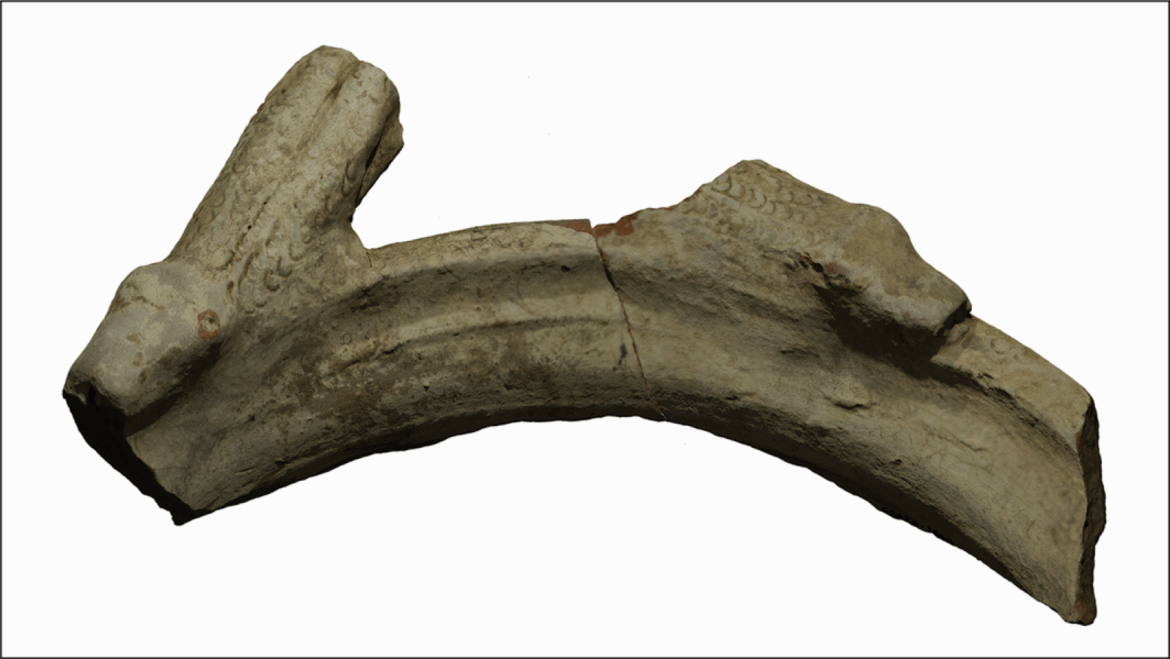
When researchers examined the ceramic shards, they identified pieces of a large vessel—measuring approximately 230 millimeters (nine inches) in diameter—featuring extraordinary relief ornamentation. The surviving handle is meticulously fashioned into a two-headed serpent, complete with rendered scales, eyes, and mouths.
Using advanced 3D reconstruction techniques, the research team matched the iconography of the vessel to the known, yet exceptionally rare, material culture of the cult of Sabazios.
- The Deity: Sabazios was originally a Thracio-Phrygian deity associated with agriculture, fertility, and divine horsemanship. As he integrated into Greek and Roman pantheons, he was often syncretized with Zeus and Jupiter.
- The Cult: Known for its ecstatic, emotional, and intensely private rituals, the worship of Sabazios was viewed with deep suspicion—and occasional public ridicule—by elite urban writers in classical Athens, who looked down upon its foreign origins.
- The Artifact: The Collet vessel represents a critical link in material culture. While serpent-decorated ceramics can occasionally appear in Mithraic or general domestic contexts, the specific morphology of the two-headed serpent handle strongly aligns with the known iconography of Sabazian mysteries.
Laboratory analyses, including optical microscopy and X-ray diffraction, revealed that the vessel was crafted from a compact red ceramic paste containing quartz, mica, and other unique minerals. Notably, its composition does not match local pottery workshops. While trace elements and a residual white slip hint at a possible African origin, researchers emphasize that provenance testing remains ongoing, and the exact manufacturing center is not yet definitively established.
Chronology: Tracing the Path of a Forgotten God
To understand how a Thracio-Phrygian mystery cult ended up in a rural Spanish villa, archaeologists must trace a complex timeline stretching across centuries and thousands of miles of Mediterranean coastline.
- Pre-Classical Origins: The worship of Sabazios developed in the mountainous regions of Thrace and Phrygia (modern-day Bulgaria, northern Greece, and central Turkey), where indigenous populations engaged in nocturnal, nature-based rituals centered around divine rebirth and sacred animals.
- Hellenistic Spread: By the classical and Hellenistic periods, the cult migrated into mainland Greece. Despite being satirized by playwrights like Aristophanes—who poked fun at the noisy rituals, foreign incantations, and ritual handling of live snakes—the mysteries continued to attract dedicated followers.
- Integration into the Roman World: As Roman hegemony expanded eastward, mystery religions found fertile ground among citizens seeking deeply personal, experiential spiritual connections that traditional state religion often failed to provide. The cult of Sabazios drifted westward, establishing minor pockets of devotion throughout the Mediterranean.
- Augustan Era in Hispania (27 B.C.E. – 14 C.E.): The archaeological context at Collet places the deposition of the vessel firmly in the Augustan period, or shortly beforehand. This chronology makes the Collet find an unusually early rural example of Sabazian-associated ceramics in the Iberian Peninsula.
- Subsequent Regional Finds: The Collet discovery does not exist in a vacuum. It corroborates a small, highly localized cluster of Sabazian artifacts previously recovered around the nearby ancient Greek and Roman city of Emporiae (modern Empúries), as well as neighboring settlements like Tolegassos and Camp de la Gruta.
Supporting Data: The Material Culture of Sabazios
Because worshippers of Sabazios typically practiced their rites in private homes (sacra privata) rather than large public temples, traditional archaeological markers like monumental architecture are absent. Instead, modern scholars must rely on a specialized, highly idiosyncratic material culture to track the cult’s footprint.
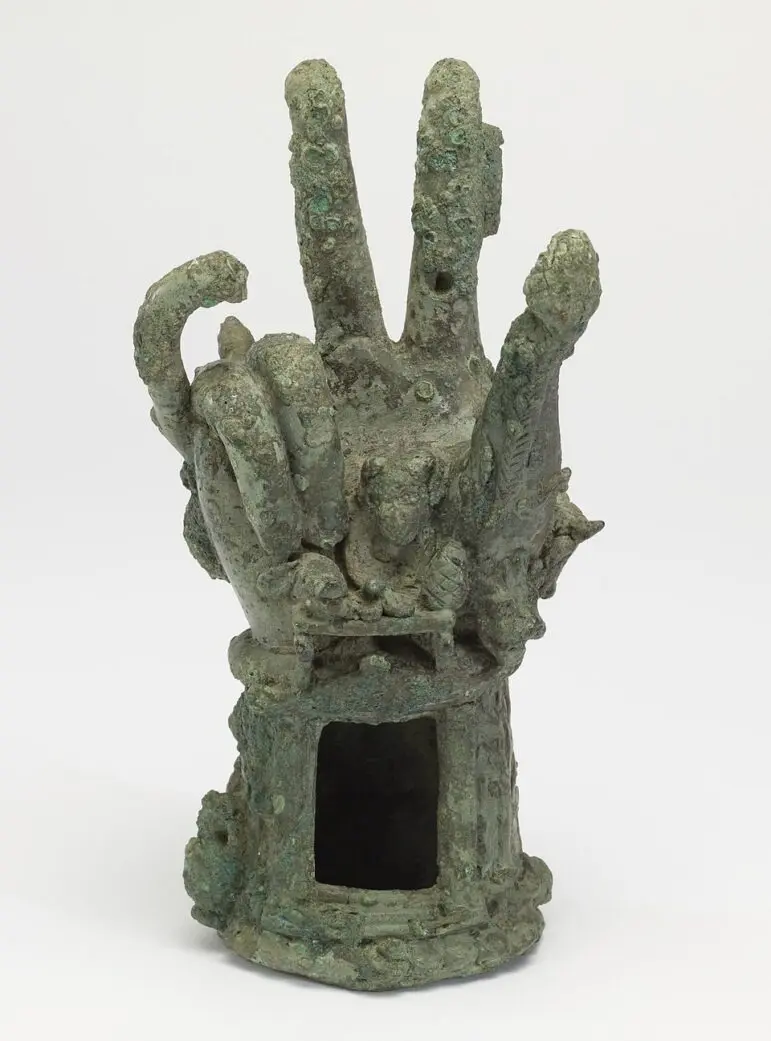
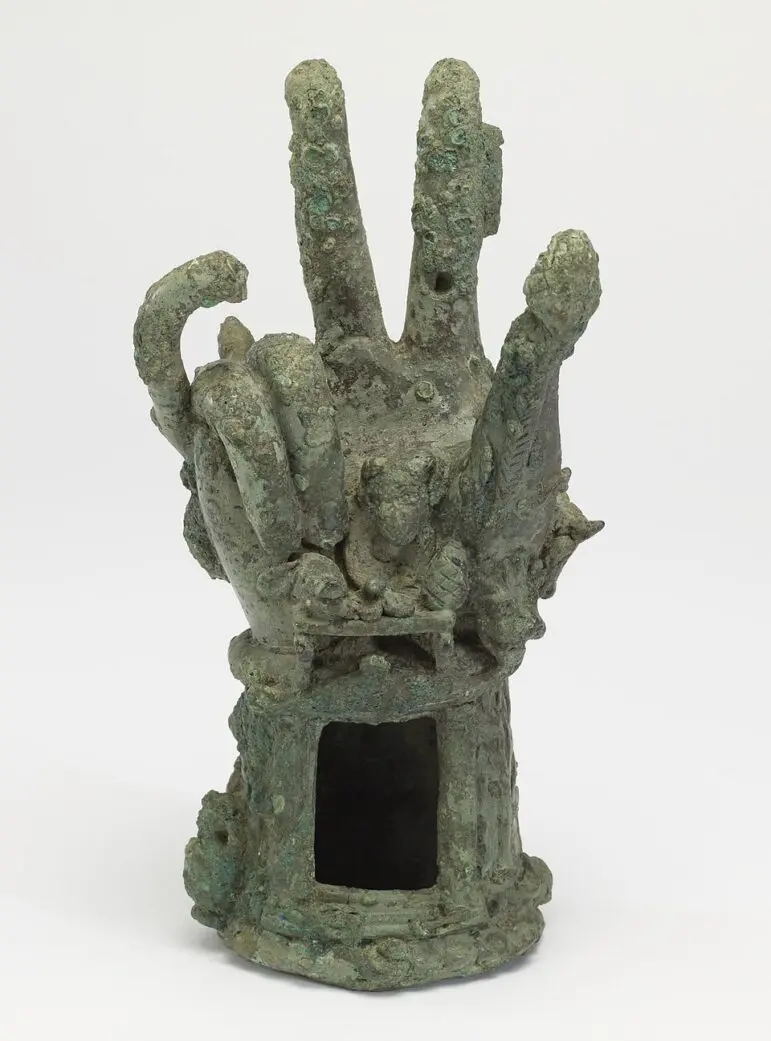
The most famous markers of the cult are bronze votive hands (known as sabazeas). These objects, often cast in copper alloy, are covered in dense religious iconography, including pinecones, thunderbolts, lizards, and, most prominently, snakes winding up the palm and fingers.
Ancient literary sources—both pagan and Christian—frequently corroborate the central theological role of serpents in these mysteries. Writers recorded initiation rites in which a live snake was dropped down or passed beneath the initiate’s garments, simulating a divine union or spiritual purification.
In the Iberian Peninsula, physical evidence of these practices has historically been exceedingly rare:

- Cartagena: A single bronze votive hand recovered from the southern coast.
- l’Alcúdia: A small bronze bust associated with the deity.
- Empúries: A remarkably preserved set of silver-plated bronze plaques forming a portable triptych. This triptych depicts Sabazios surrounded by traditional symbols alongside the divine twins, Castor and Pollux (the Dioscuri).
The discovery at Collet adds vital domestic and ceramic data to this metal-heavy archaeological record. It shifts our view of the cult from elite, highly portable ritual objects owned by traveling priests to everyday domestic spaces used by rural landowners or estate managers.
Official Responses and Academic Perspectives
The publication of the study in Antiquity has drawn praise from classical historians and Mediterranean archaeologists alike, who view the paper as a masterclass in extracting profound historical narratives from fragmented domestic debris.
"For a long time, mystery cults like that of Sabazios were viewed through the distorted lens of elite literature—either as dangerous foreign crazes or eccentric oddities," noted an independent classical archaeologist not involved in the study. "What Bouzas Sabater and his colleagues have done is anchor this elusive cult into the gritty, everyday reality of provincial agricultural life."
The researchers themselves argue that the concentration of snake-decorated ceramics around Emporiae points toward a deliberate mechanism of transmission. They hypothesize that an itinerant Sabazian priest—perhaps operating out of the major trading hub of Emporiae—may have acted as a spiritual vector, carrying the mysteries inland.
"These artifacts suggest that the spread of mystery cults was not merely an urban phenomenon," the research team noted in their study summary. "Religious entrepreneurs or traveling initiates could carry these traditions deep into the rural countryside, integrating them seamlessly into the private devotional lives of provincial estates."
Implications: Rewriting the Religious Map of the Roman West
The implications of the Collet villa discovery extend far beyond a single broken pot. They challenge how modern historians conceptualize religious globalization in the ancient world.

1. Decentralized Religious Networks
The find demonstrates that ancient globalization was not a one-way street dictated solely by imperial edicts from Rome. Instead, spiritual traditions from the distant Thracian borderlands could organically permeate the Western provinces, finding a home among provincial elites and rural laborers alike.
2. The Power of Sacra Privata
By operating within the private sphere, mystery cults bypassed the need for monumental infrastructure. The Collet vessel suggests that a landowner in Hispania could participate in ecstatic, foreign rites behind closed doors, maintaining dual religious identities: participating in civic Roman religion outwardly while harboring intensely personal, mystery-based devotions at home.
3. Future Archaeological Horizons
The scarcity of Sabazian artifacts in Spain has long led scholars to assume the cult was virtually non-existent there. The identification of the Collet vessel suggests a methodological shift is needed. Archaeologists re-examining ceramic fragments from rural Roman villas across Europe may find that these mysterious cults were far more widespread than previously imagined, hiding in plain sight among the broken pottery of antiquity.
As researchers continue to analyze the mineral signatures of the Collet ceramic and scan surrounding strata for further clues, the two-headed serpent of Calonge i Sant Antoni stands as a silent sentinel from the past—a reminder that the spiritual landscape of the Roman Empire was infinitely more diverse, interconnected, and mysterious than the grand ruins left behind would suggest.