








Main Facts
In the industrial waterfront neighborhood of Red Hook, Brooklyn, a 7,000-square-foot former manufacturing space hums with a distinct kind of creative energy. This is Piscina, a multidisciplinary design studio and collaborative collective founded by Cuban-American artist Natalie Shook. Far from a conventional white-cube gallery that occasionally dabbles in merchandise, Piscina operates as an incubator of tactile creation—a dynamic ecosystem where woodworkers, ceramicists, metalsmiths, and conceptual designers share floor space, tools, and ideas.
At the center of this hive is Shook, whose own trajectory from a Midwestern childhood of solitary painting to a bustling Brooklyn fabrication floor mirrors the ethos of her studio. Piscina is built on the premise that contemporary design does not need to emerge from a single, isolated genius. Instead, it champions a communal approach where the collective friction of twenty artists solving problems simultaneously leaves an indelible mark on every piece of furniture, ceramic vessel, and cast-iron object that leaves the workshop.
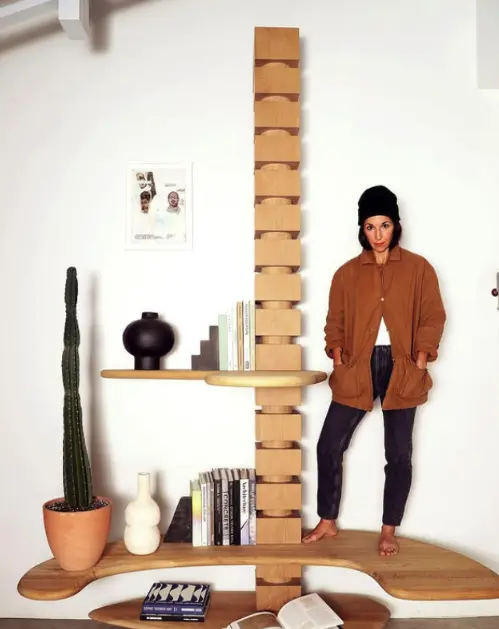
The studio’s breakout moment arrived at the International Contemporary Furniture Fair (ICFF) in 2022, where its debut collection stunned critics and jurors alike, sweeping the categories for Best New Designer and Best in Show. Anchored by a monumental solid oak shelving unit—a hybrid of micro-architecture and heavy-duty functional furniture—Piscina’s catalog defies easy categorization. The work is physical, tactile, and deliberately weighty, designed for environments where objects are meant to be touched, leaned against, and lived with rather than merely admired from behind a velvet rope.
Chronology
The Formative Years in the Midwest and Cooper Union
Natalie Shook’s artistic journey began early. By the age of 14, she had committed herself to a daily artistic practice, operating under the assumption that defined most young artists of her generation: that she was, fundamentally, a painter. Born and raised in the Midwest, Shook nurtured this belief through years of canvas-based exploration, focusing on two-dimensional composition, color theory, and traditional representation.
This singular focus brought her to New York City, where she enrolled in the prestigious Cooper Union to study painting. However, the urban environment and the rigorous, exploratory curriculum at Cooper Union acted as a crucible, melting away long-held assumptions. Surrounded by spatial thinkers, architects, and fabricators, Shook discovered a latent, powerful affinity for carpentry and physical construction.
The Material Turn
The shift from canvas to timber and metal was not instantaneous, but it was absolute. Shook found herself increasingly drawn away from the flat plane and toward objects that possessed physical presence—things she could touch, sit on, lean against, and imbue with structural weight. This realization necessitated a reinvention of her practice. No longer content with the illusion of depth on a canvas, she began exploring actual depth, load-bearing capacities, and the tactile honesty of raw materials.
This pivot eventually laid the groundwork for Piscina. Recognizing that the most compelling work often happens at the intersection of multiple disciplines, Shook envisioned a space that would bridge the gap between individual studio practice and communal production. She secured a sprawling 7,000-square-foot industrial loft in Red Hook, Brooklyn—a neighborhood historically shaped by maritime trade, shipping, and heavy industry—and transformed it into a shared workspace.
The 2002 ICFF Breakthrough
After years of quiet incubation, experimentation, and community-building within the Red Hook walls, Piscina made its official public debut at the International Contemporary Furniture Fair (ICFF) in 2022. The design world took immediate notice. Competing against established international heavyweights and slick commercial brands, Piscina’s raw, unapologetically tactile collection captured the attention of the jury, walking away with both Best New Designer and Best in Show honors.
The centerpiece of that exhibition—a towering, architecturally complex solid oak shelving unit—became an instant icon of the fair, signaling a broader cultural appetite for work that balances rigorous structural integrity with emotional resonance. Since then, Piscina has transitioned from a localized experiment into a recognized force in contemporary American design, continually expanding its output while maintaining its rigorous, hands-on fabrication roots.
Supporting Data and Spatial Dynamics
Inside the 7,000-Square-Foot Red Hook Workshop
To understand Piscina is to understand its physical environment. Situated in Red Hook, a Brooklyn enclave known for its cobblestone streets and maritime heritage, the studio occupies an expansive 7,000-square-foot footprint that functions as part factory, part laboratory, and part salon.
The space is intentionally unpretentious. Saws buzz on the communal woodworking floor, where sawdust settles on workbenches shared by multiple makers. Just a few feet away, pottery wheels whir inside a sun-drenched ceramic studio, while metalsmiths weld and cast elements in adjacent zones. This spatial layout fosters a continuous cross-pollination of techniques. A ceramicist might consult a woodworker on the base of a vessel; a metalsmith might advise on hardware for a shelving unit.

+-------------------------------------------------------+
|                 PISCINA WORKSHOP MAP                  |
|                                                       |
|  +-----------------------+  +----------------------+  |
|  |   Woodworking Floor   |  |   Ceramic Studio     |  |
|  |   (Saws, Joinery,     |  |   (Pottery Wheels,   |  |
|  |    Large-Scale Oak)   |  |    Light-Filled)     |  |
|  +-----------------------+  +----------------------+  |
|             |                           |             |
|             +-------------+-------------+             |
|                           |                           |
|                           v                           |
|              +--------------------------+             |
|              |     Metalsmithing &      |             |
|              |     Casting Zone         |             |
|              +--------------------------+             |
|                           |                           |
|                           v                           |
|              +--------------------------+             |
|              |     Final Assembly &     |             |
|              |     Exhibition Gallery   |             |
|              +--------------------------+             |
+-------------------------------------------------------+
Materiality and the Primacy of the Sketch
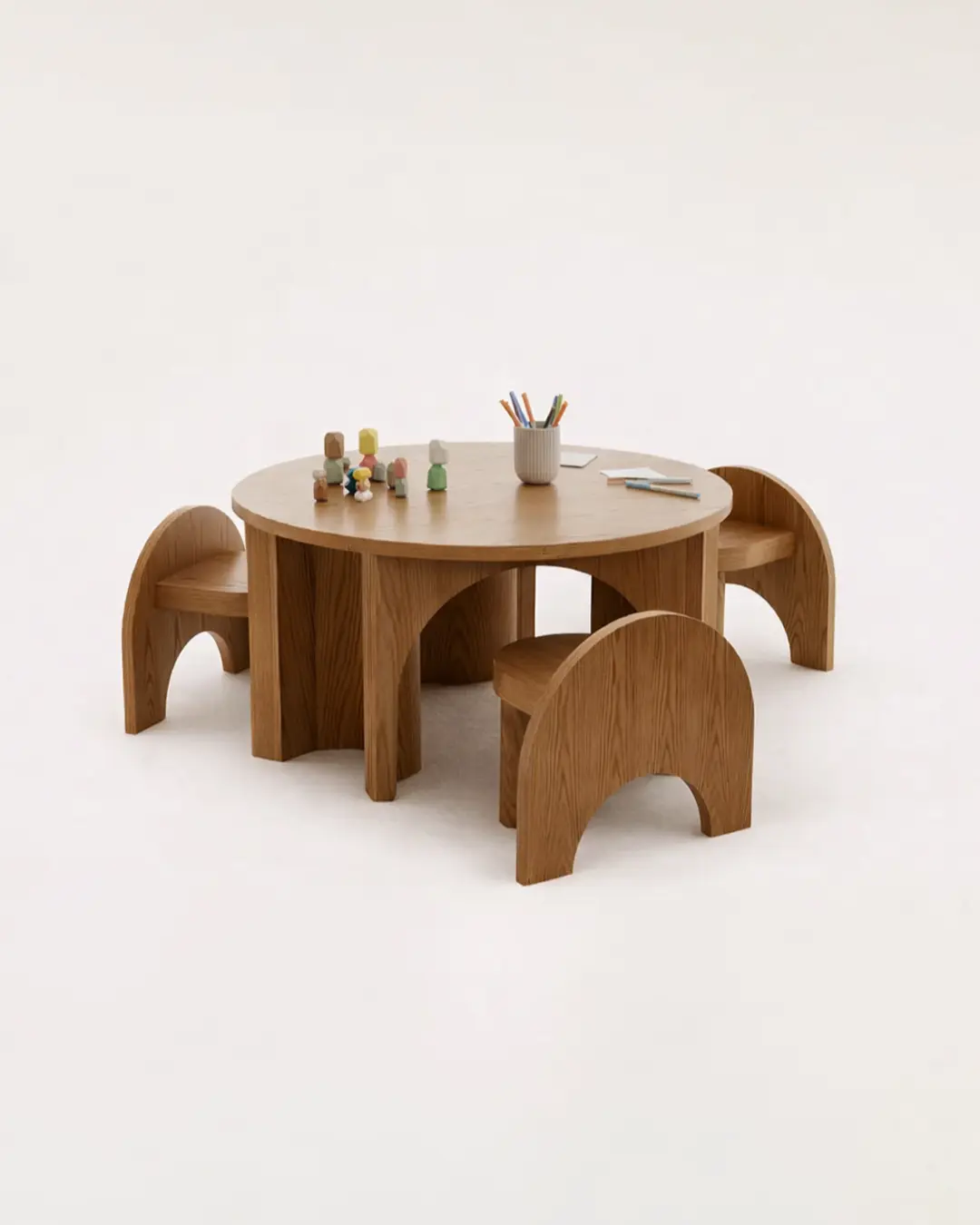
Piscina’s catalog is defined by an uncompromising approach to materials. Whether working with solid domestic oak, high-fired ceramics, or heavy cast iron, the studio rejects superficial finishes in favor of structural honesty.
A critical component of Piscina’s methodology is its treatment of two-dimensional design. Rather than treating hand-drawn sketches as ephemeral preliminary steps to be discarded once the object is built, the studio regards drawings as primary, intimate documents of creative intuition. In the world of Piscina, the sketches and the final objects exist in a symbiotic dialogue: the sketches contain the DNA of the future object, and the finished piece carries the ghost of the hand-drawn line within its grain, weight, and silhouette.
Featured Piece: The Oak Shelving Unit
- Object: Solid Oak Shelving Unit
- Origin: Made in Red Hook, Brooklyn, by Piscina
- Design Characteristics: A towering stack of geometric forms that blurs the boundary between micro-architecture and functional furniture. Crafted from heavy-gauge solid oak, the piece plays with negative space, load distribution, and visual rhythm, serving as both a storage system and a monumental sculpture.
- Aesthetic Classification: Specific, highly considered, and resistant to standard commercial categorization.
Official Responses and Creative Philosophy
The philosophy driving Piscina is perhaps best understood through Natalie Shook’s own reflections on identity and collaboration. When asked about her transition from painting to large-scale fabrication, Shook often speaks to the realization that creative identity does not have to be singular.
"She is, it turns out, many people trying to be one person. That’s not a problem. That’s the whole point of Piscina."
This sentiment captures the collective ethos of the studio. In an industry that frequently prizes individual authorship and personal branding, Piscina deliberately diffuses credit across a network of makers. The studio functions as a collective organism where individual eccentricities and specialized skills are absorbed into a unified aesthetic output.
Design critics and curators who have engaged with Piscina’s work frequently emphasize this communal energy. Industry insiders note that objects emerging from Red Hook carry a palpable sense of human labor—a counter-narrative to an increasingly digitized and automated global design market. By maintaining a physical workspace where twenty artists solve structural and aesthetic problems simultaneously, Piscina ensures that its pieces are saturated with the dynamic friction of collective human endeavor.
Implications for Contemporary Design
Piscina’s success at ICFF and its ongoing residency in Red Hook point to several broader shifts within contemporary furniture and object design.
1. The Revival of Localized, Industrial-Scale Craft
For decades, the dominant economic model for independent designers involved outsourcing fabrication to overseas factories, minimizing local footprint to maximize profit margins. Piscina represents a counter-movement: the revitalization of urban manufacturing hubs. By anchoring itself in Red Hook—an area steeped in industrial history—the studio proves that high-end, critically acclaimed design can be conceived, built, and tested under a single roof in a major American city.
2. The Blur Between Art, Architecture, and Furniture
The boundary-defying nature of Piscina’s oak shelving units and cast-iron objects reflects a growing market appetite for functional art. Consumers and collectors are increasingly turning away from mass-produced homogeneity, seeking out objects that carry architectural presence and narrative depth. When a bookshelf reads like a building and a ceramic vessel feels like a monument, domestic spaces transform into curated environments of contemplation.
3. Redefining Collective Authorship
The traditional design studio model—where a single master designer signs off on work executed anonymously by fabricators—is being challenged by collaborative collectives like Piscina. By positioning the studio as a porous ecosystem where woodworkers, ceramicists, and metalsmiths share intellectual and physical labor, Piscina points toward a more sustainable and equitable future for craft-based industries. In this model, the studio is not just a commercial enterprise, but a cultural institution fostering community, mentorship, and shared innovation in the heart of Brooklyn.