










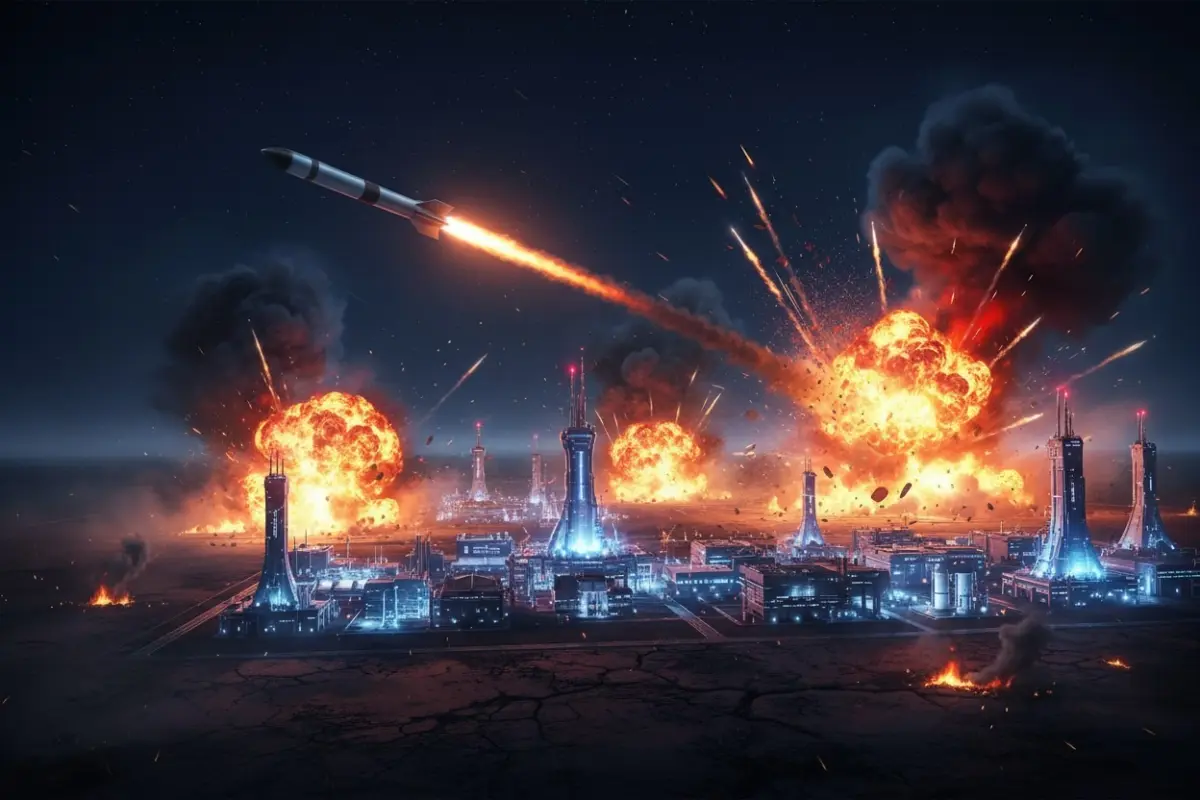
KYIV — Hopes for a diplomatic breakthrough evaporated this week as peace negotiations officially collapsed, immediately followed by a devastating, large-scale Russian overnight assault targeting Ukraine’s core military-industrial complex. The coordinated strikes, which utilized high-precision long-range munitions and swarms of loitering drones, targeted defense production facilities, cruise missile storage depots, and crucial logistical hubs across Kyiv, the surrounding region, and the southern port areas of Odessa.
The violent escalation occurred mere hours after U.S. peace negotiators departed the Ukrainian capital following a fruitless round of high-level talks. The timing has underscored a deepening diplomatic stalemate and a total breakdown in communication between Moscow and Kyiv. As the conflict grinds past its fourth year, the latest offensive marks a sinister strategic pivot by the Kremlin: shifting away from scattered energy grid attacks to a concentrated, systematic effort to dismantle Ukraine’s domestic weapons manufacturing and supply chain infrastructure.
With civilian casualties mounting, humanitarian organizations issuing dire warnings ahead of the winter season, and global markets reacting to the hardening of positions, the war has officially entered a perilous new phase defined by total industrial attrition and the complete abandonment of peace channels.
Main Facts
The overnight bombardment represented one of the most technologically focused and geographically dispersed strikes launched by Russian forces in recent months. According to operational briefings from the Russian Defense Ministry, the barrage specifically targeted nodes critical to sustaining Ukraine’s frontline military operations.
- Target Profiles: High-precision weapons and long-range drones struck domestic drone production plants, advanced cruise missile storage depots, logistics centers handling military cargo, and critical fuel distribution nodes.
- Geographic Scope: The heaviest impacts were recorded in Kyiv and the surrounding metropolitan region, as well as critical port infrastructure in Chornomorsk within the Odessa oblast. Secondary strikes were similarly reported by regional monitors in Kharkiv and Mykolaiv.
- Timing and Diplomacy: The offensive directly coincided with the collapse of international peace talks mediated in part by U.S. diplomats, whose departure from Kyiv signaled an immediate return to high-intensity kinetic warfare.
- Casualties and Infrastructure Damage: While Russian authorities maintained that the strikes exclusively targeted military and defense assets, Ukrainian officials and international monitors confirmed substantial civilian casualties, including dozens of injuries and fatalities among non-combatants, alongside widespread destruction to residential areas, apartment complexes, and schools.
- Strategic Shift: Defense analysts note that Moscow is systematically attempting to strangle Kyiv’s indigenous capacity to manufacture armor, missiles, and unmanned aerial vehicles, compounding the economic and material strain on an already heavily taxed Ukrainian defense apparatus.
Chronology of Escalation
To understand how the current crisis unfolded, it is necessary to examine the rapid succession of events that transitioned the region from tentative diplomatic posturing to all-out industrial warfare.
Phase 1: The Diplomatic Deadlock
Throughout the preceding weeks, international intermediaries—led by Western diplomats, including U.S. peace negotiators stationed in Kyiv—pushed aggressively for a localized ceasefire and the resumption of formal peace talks. Moscow, however, consistently rebuffed Kyiv’s non-negotiable demand for an unconditional ceasefire and the full restoration of pre-conflict territorial integrity. As negotiating tables stalled, intelligence services on both sides noted a massive repositioning of strategic missile reserves and long-range drone units.
Phase 2: The Departure of Envoys and Initial Movements
By mid-week, it became apparent that the diplomatic mission had failed to bridge the fundamental gaps between the belligerents. Within hours of the U.S. diplomatic delegation departing Kyiv, air raid sirens wailed across multiple Ukrainian oblasts. Russian long-range aviation and drone command units received the authorization to execute a pre-planned, coordinated campaign against deep-rear military production nodes.
Phase 3: The Overnight Barrage
Beginning late in the evening and stretching into the early morning hours, waves of precision-guided munitions and suicide drones saturated airspace from the capital down to the Black Sea coast. Explosions rocked suburban manufacturing districts in Kyiv, where defense contractors produce vital tactical drones. Simultaneously, logistics hubs feeding the eastern and southern fronts were systematically targeted, alongside fuel tankers and transit depots designed to keep armored brigades operational.
Phase 4: Immediate Aftermath and Humanitarian Shockwaves
As dawn broke, emergency response teams rushed to sites in Kyiv, Kharkiv, and Mykolaiv. The sheer volume of secondary detonations at alleged weapons and fuel depots magnified the blast radius, resulting in catastrophic damage to adjacent civilian apartment blocks. Hospitals in the capital were immediately overwhelmed with casualties, triggering a frantic scramble for blood donations and emergency medical supplies as the scale of the destruction became fully apparent.
Supporting Data and Humanitarian Toll
While military analysts scrutinize the tactical implications of degraded supply chains, the human cost of the strikes has sparked international condemnation and heightened humanitarian alarm.
Casualty Metrics and Civilian Impact
Ukrainian authorities reported a devastating civilian toll stemming from the collateral effects of the industrial strikes. In Kyiv alone, emergency services confirmed that scores of individuals were injured—including a significant number of children—while residential apartment complexes suffered structural collapses from blast waves and intercepted drone debris. Independent reports from the Times of India and regional monitors corroborated similar devastation in Kharkiv and Mykolaiv, where educational institutions and residential neighborhoods were struck by errant munitions or close-proximity impacts.
+-------------------------------------------------------------------+
|               ESTIMATED CONFLICT IMPACT METRICS                   |
+---------------------------+---------------------------------------+
| Metric                    | Status / Figure                       |
+---------------------------+---------------------------------------+
| Displaced Persons         | Over 1.5 million newly displaced      |
| Regional Infrastructure   | Widespread grid and thermal failures  |
| Healthcare Strain         | Critical deficits in urban hospitals  |
| Industrial Targets Hit    | Defense plants, fuel depots, ports    |
+---------------------------+---------------------------------------+
The Looming Humanitarian Catastrophe
The timing of the attacks—occurring just as seasonal temperatures begin to plummet—has exacerbated fears of a humanitarian disaster.
- Displacement: Over 1.5 million Ukrainians have been forced to flee their homes due to the recent wave of escalations, compounding the country’s internal refugee crisis.
- Infrastructure Vulnerabilities: Previous systematic targeting of electrical substations, metallurgical plants in the Dnepropetrovsk region, and logistics hubs in Nikolaev and Odessa has left Ukraine’s power grid highly fragile.
- The "Winter of Death": International aid organizations and humanitarian agencies have issued stark warnings. Without reliable heating, electricity, and functional medical facilities in bombed-out urban centers, the vulnerable civilian population faces what relief workers are terming a potential "winter of death."
Official Responses
The collapse of peace talks and the subsequent devastation of industrial zones have drawn sharp, polarized reactions from the international community and domestic leadership alike.
Kyiv’s Stance and Western Appeals
Ukrainian leadership reacted with profound outrage while doubling down on calls for immediate international intervention and military resupply. President Volodymyr Zelensky vehemently condemned the strikes as deliberate acts of terror designed to break the psychological resilience of the Ukrainian people.
In public addresses following the attack, Kyiv’s administration reiterated that Russia has zero genuine interest in peace, pointing to Moscow’s rejection of unconditional ceasefires. Zelensky’s office issued urgent appeals to Washington, Brussels, and other Western allies for expedited shipments of advanced air defense systems—specifically additional Patriot and NASAMS batteries—along with long-range strike capabilities to deter further Russian bombardments. Ukrainian officials stressed that without a massive influx of financial and military aid, the domestic defense industry’s capacity to sustain frontline units will face critical bottlenecks.
Moscow’s Justification
Conversely, the Russian Ministry of Defense defended the overnight operation, maintaining that all targeted sites strictly adhered to legitimate military parameters. Moscow asserted that the barrage successfully neutralized critical nodes of Ukraine’s war-fighting machine, explicitly citing the destruction of unauthorized drone assembly plants, underground cruise missile storage bunkers, and fuel logistical networks necessary for sustaining combat operations.
Russian state media framed the operation as a necessary and proportionate response to ongoing Ukrainian provocations and an inevitable step in neutralizing foreign-supplied military infrastructure. Kremlin spokespersons reiterated that military operations will continue unabated until Moscow’s strategic objectives—including the demilitarization of the Ukrainian state—are fully accomplished.
International Reactions
Global capitals have expressed deep concern over the dual collapse of diplomacy and the intensification of industrial warfare. European Union leaders condemned the strikes on civilian areas while reaffirming their commitment to long-term financial packages for Kyiv. Meanwhile, neutral nations and international bodies have renewed calls for an immediate cessation of hostilities, though analysts note that the departure of U.S. negotiators leaves a dangerous vacuum in high-level diplomatic mediation.
Strategic Implications
The convergence of failed peace talks and the systematic destruction of defense manufacturing assets signals a profound structural shift in the trajectory of the war.
From Territorial Control to Economic Attrition
For years, the conflict was largely evaluated through the lens of territorial gains and losses along static frontline trenches. However, the 2026 campaigns—highlighted by the targeting of metallurgical plants in Dnepropetrovsk, electrical substations in Nikolaev, and now defense complexes in Kyiv and Odessa—demonstrate that the war has decisively transformed into a war of industrial and economic attrition.
By systematically degrading Ukraine’s domestic capacity to produce armored vehicles, drones, and precision munitions, Russia is attempting to create an irreversible military imbalance. Even if Western allies continue to supply weaponry, the loss of indigenous manufacturing infrastructure forces Kyiv into a position of total logistical dependency on foreign aid.
The Breakdown of Diplomatic Channels
The immediate transition from peace negotiations to a massive aerial bombardment underscores the acute fragility of current diplomatic frameworks. With Moscow demanding capitulation-style terms and Kyiv insisting on total territorial restoration, compromise has become functionally impossible. The failure of U.S. mediators to secure even a temporary cessation of hostilities suggests that neither side currently perceives an advantage in compromise, virtually guaranteeing that the conflict will rage on through the foreseeable future.
Global Repercussions
The escalation carries profound implications for global security, energy markets, and international stability. As supply chains remain disrupted and humanitarian crises deepen, the international community faces mounting pressure to address both the immediate suffering of millions of displaced Ukrainians and the long-term geopolitical fallout of a protracted, unbounded European war.
Ultimately, as winter approaches and the smoke clears from the latest devastating strikes, the landscape of Ukraine remains one of unyielding defiance tempered by profound suffering—a stark reminder that peace remains a distant horizon while the engines of industrial warfare continue to turn.