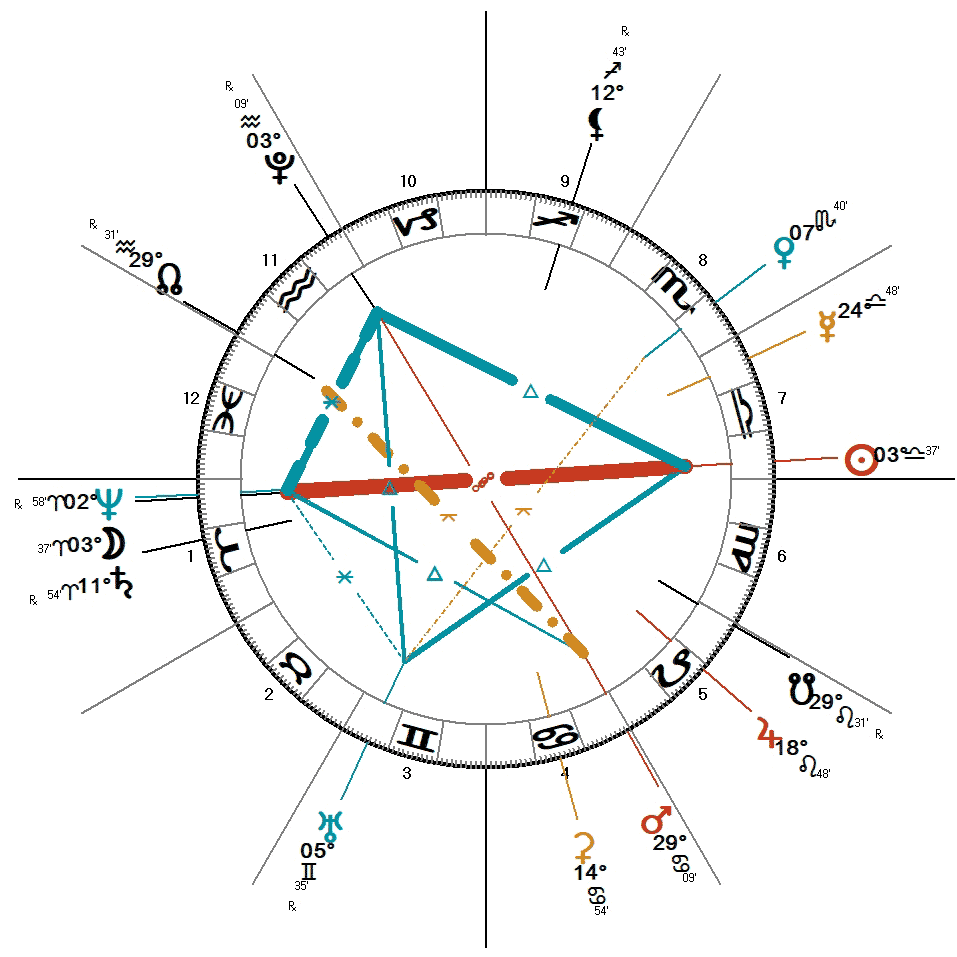









In the realm of astrology, few planetary shifts present as compelling a paradox as the transition of Mars—the traditional archetype of war, raw drive, impulse, and physical assertion—into the sensitive, watery domain of Cancer. Governed by the Moon, Cancer is an energy characterized by shells, tides, memory, and the preservation of emotional safety. When the cosmic warrior enters this cardinal water sign, the nature of conflict shifts entirely. The sword is laid down not out of weakness, but to pick up a shield. The battlefield moves from the open plains of conquest to the hearth, the home, and the inner sanctum of the human heart.
As this astrological transit unfolds, astrologers and observers of collective behavior note a distinct pivot in how motivation, anger, and courage manifest. Action is no longer guided by reckless impulse; instead, it is directed by profound emotional currents. Courage is redefined: it is no longer about winning an external war, but about defending what is sacred.
Main Facts: Decoding the Mars in Cancer Archetype
At its core, the Mars in Cancer transit forces a marriage between two seemingly incompatible forces: the masculine drive of Mars and the deeply feminine, receptive matrix of Cancer.
- The Shift in Motivation: Mars typically demands forward momentum, speed, and direct confrontation. In Cancer, this fiery momentum is checked by caution. Action becomes deliberate, cautious, and deeply personal. We do not fight simply to win; we fight because our emotional security, our families, or our foundational roots are threatened.
- The Defensive Posture: Just as a crab retreats into its shell when threatened, individuals under this transit may become more guarded. The energy favors the creation of safe havens, fortifying domestic spaces, and establishing firm boundaries against external chaos.
- The Power of Passive Resistance: Open, aggressive confrontation is rarely the hallmark of Mars in Cancer. Instead, this placement is notorious for passive-aggressive tendencies, silent treatments, and covert operations. When anger arises, it often stews beneath the surface, manifesting as emotional withdrawal or stubborn, unyielding resistance.
- The Protective Instinct: Despite its potential for defensiveness, this transit endows individuals with fierce loyalty. The vulnerable, the young, and the marginalized find unexpected champions during this period. The protective instinct extends beyond biological family to include close-knit communities and cherished memories of the past.
Chronology and Evolution of the Transit: From Spark to Shell
To fully understand the impact of Mars in Cancer, one must trace its psychological and energetic progression from its initial ingress to its eventual departure.
Phase 1: The Initial Ingress and Stirring Tides
As Mars first steps into Cancer, the immediate atmospheric shift can feel jarring. Individuals accustomed to high-speed productivity and intellectualized decision-making may suddenly experience a wave of lethargy or emotional distraction. The initial phase of the transit acts as an awakening of buried sentiments. Unresolved domestic tensions or old family dynamics that were easily ignored during fire or air transits suddenly demand attention. The collective mood turns inward. People begin auditing their lives, asking fundamental questions: Where do I feel safe? Who truly has my back? Am I expending energy on battles that do not nourish my soul?
Phase 2: The Deepening Waters and Hidden Conflicts
As the transit matures, the energetic focus centers heavily on the domestic sphere and interpersonal relationships. This is the period where hidden resentments are most likely to surface. Because Mars in Cancer struggles to articulate anger cleanly and directly, misunderstandings can fester. Passive-resistance becomes a common behavioral pattern in workplaces and households alike. However, this phase also provides a crucible for emotional catharsis. Old emotional wounds—particularly those stemming from childhood or foundational conditioning—rise to the surface. While challenging, this friction offers a rare window for profound healing, transforming raw pain into hard-won compassion.

Phase 3: The Consolidation of Safe Havens
In the final stages of the transit, the frantic energy of adjustment settles into a protective, fortress-like stability. Having identified vulnerabilities and addressed domestic fractures, individuals and communities focus on fortification. This is an optimal time for home renovations, strengthening family bonds, and solidifying emotional support networks. The warrior has now successfully secured the castle walls, establishing a durable perimeter of emotional and physical security before Mars eventually moves on to test its strength in the blazing fires of Leo.
Supporting Data and Astrological Frameworks: Mapping the Houses
In professional astrological practice, the impact of Mars in Cancer cannot be generalized entirely to the collective; its true manifestation depends heavily on the specific astrological house it illuminates in an individual’s natal chart.
Astrologers meticulously analyze these house placements to determine precisely where the native will be stimulated to take action:
- Angular Houses (1st, 4th, 7th, 10th): When Mars in Cancer transits these sensitive angles, the need to protect home, career foundations, or primary partnerships becomes an urgent, public matter. Domestic life may experience sudden shake-ups that require immediate, protective intervention.
- Succedent Houses (2nd, 5th, 8th, 11th): Here, the energy shifts toward safeguarding resources, creative projects, shared finances, or social alliances. Financial caution mixes with deep emotional investments.
- Cadent Houses (3rd, 6th, 9th, 12th): In these domains, the transit stimulates internal processing, health routines, and spiritual or psychological healing. The "battlefield" is internal, fought through therapy, journaling, and quiet endurance.
Furthermore, historical observations of collective moods during Mars-in-Cancer cycles consistently reveal spikes in real estate fortification, a heightened focus on national security and domestic policy within governments, and an increased cultural emphasis on ancestral heritage, genealogy, and family history.
Official Perspectives and Archetypal Echoes: The Wisdom of Quan Yin
While astrology provides the mechanical framework of the transit, mythology and cultural archetypes offer profound roadmaps for how to navigate its highest expressions. A brilliant mirror for Mars in Cancer is found not in a traditional mythological god of war like Mars or Ares, but in the revered figure of Goddess Quan Yin, the Bodhisattva of Compassion.
At first glance, pairing a deity of supreme mercy with the astrological ruler of aggression seems counterintuitive. However, Quan Yin embodies the ultimate, evolved manifestation of Mars in Cancer: strength channelled through fierce, uncompromising protection of the vulnerable.

Reflecting on this archetype, esoteric scholars note that Quan Yin’s devotion to nurturing and liberating all sentient beings requires immense, unshakeable courage. It is a courage that does not rely on weapons, domination, or ego. Instead, it is rooted in emotional intelligence, radical empathy, and the quiet, revolutionary power of unconditional love.
During the Mars in Cancer transit, the Quan Yin archetype serves as a guiding light. It reminds humanity that true power is often found in gentleness. When the world feels threatening, our greatest defense is not a raised fist, but an open, protected heart capable of nurturing life through the darkest of tides.
Implications for the Collective: Navigating the Tides
As communities and individuals move through the energetic currents of Mars in Cancer, the practical implications for daily life are vast.
- Redefining Conflict Resolution: Because direct, aggressive confrontation often backfires during this transit, society is forced to adopt more emotionally intelligent communication styles. We must learn to listen to the subtext of anger—recognizing that outbursts or cold withdrawals are frequently masks for fear, exhaustion, or a desperate need for safety.
- Prioritizing Mental and Emotional Health: The rising tide of suppressed memories and old wounds demands robust self-care practices. Communities that invest in mental health resources, domestic support systems, and community care networks will navigate this transit with far greater resilience.
- The Sanctity of the Home: In an increasingly fast-paced and digitized world, Mars in Cancer serves as a necessary cosmic anchor, forcing a collective re-evaluation of work-life balance. Protecting our private lives, nurturing our families, and establishing sacred boundaries against external stressors become essential acts of survival and rebellion.
Ultimately, Mars in Cancer teaches us that vulnerability and strength are not mutually exclusive. Behind the heavy stone walls of the castle lies a warm hearth, sustained by a warrior who fights not out of hatred for what is outside, but out of a fierce, abiding love for what is within.