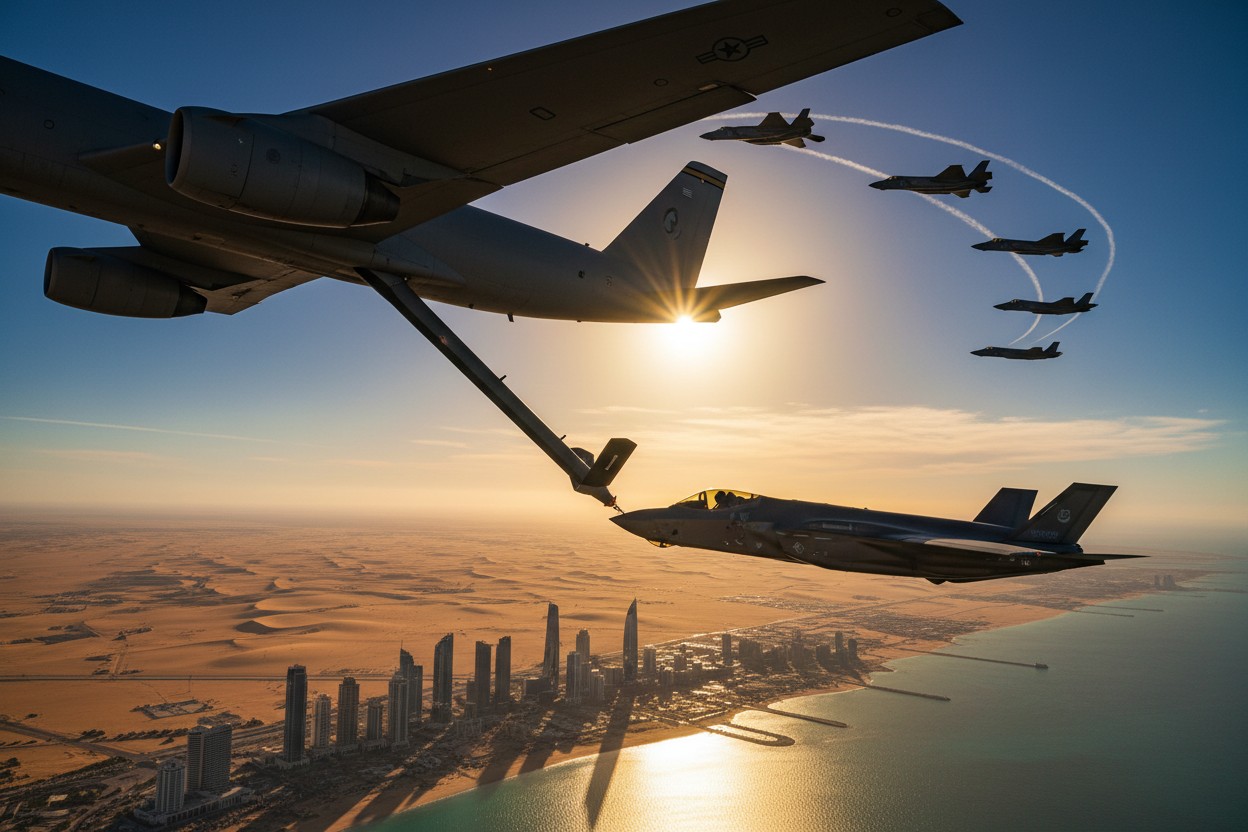
WASHINGTON — In a major move aimed at bolstering Gulf security, the U.S. Department of State has approved a potential Foreign Military Sale (FMS) to Qatar featuring up to four Boeing KC-46A Pegasus aerial refueling aircraft and associated logistics, defense systems, and technical support. The prospective package carries an estimated total price tag of $4.50 billion, according to a formal announcement released by the Defense Security Cooperation Agency (DSCA) on August 20.
While the transaction still requires congressional review and final contract negotiations, the proposed deal highlights Washington’s deepening security commitments to key Middle Eastern partners. It arrives at a volatile moment for the region, as Gulf nations navigate relentless aerial campaigns and cross-border missile strikes stemming from the broader conflict between the United States, Israel, and Iran.
Main Facts of the Proposed Sale
The prospective $4.50 billion arms package is designed to dramatically upgrade Qatar’s long-range power projection, logistical staying power, and tactical coordination with American and allied military branches.
At the center of the acquisition are up to four KC-46A Pegasus multi-role tanker and transport aircraft, manufactured by The Boeing Company. Beyond the airframes themselves, the comprehensive foreign military sale encompasses an extensive suite of defense electronics, defensive countermeasures, secure communications gear, and maintenance logistics.
According to the State Department’s Bureau of Political-Military Affairs, the primary components of the proposed package include:
Airframes and Propulsion: Four KC-46A Pegasus aerial refueling aircraft equipped with high-bypass turbofan engines supplied by Pratt & Whitney Military Engines.
Defensive Systems: Advanced missile warning sensors, electronic warfare database support, and cartridge-actuated devices designed to improve aircraft survivability in contested airspace.
Communication & Cryptography: Specialized control interface units, KIV-77 crypto modules, and KY-100M crypto terminals ensuring secure, jam-resistant tactical networking.
Logistics and Support: Comprehensive technical documentation, spare parts, ground support equipment, operator and maintenance training, and U.S. government and contractor engineering technical services.
The primary defense contractors slated to execute the contract—should it pass the congressional review phase—include The Boeing Corporation, Pratt & Whitney Military Engines, RTX Corporation, and Northrop Grumman Corporation. U.S. officials confirmed that they are not aware of any proposed offset agreements connected to this specific foreign military transaction.
Chronology of Escalation: The Gulf Conflict
The timing of the KC-46A approval underscores the perilous security landscape currently facing the Arabian Peninsula. The region has experienced a sharp uptick in kinetic warfare following the outbreak of direct, open hostilities between Washington and Tehran.
Late February: The Outbreak of Major Combat Operations
The current cycle of regional escalation ignited in late February, when the United States launched what it termed "major combat operations" against Iranian targets, operating in tandem with Israeli military forces. The conflict immediately spilled across borders, transforming the Middle East into an active theater of operations.
March–June: Satellite Evidence and the Toll on Regional Infrastructure
According to satellite imagery analysis published by BBC Verify, Iranian military forces have systematically targeted critical infrastructure and military nodes across eight countries in the Middle East since the fighting began. These strikes have inflicted millions of dollars in cumulative damage, heavily impacting regional air defense installations, early-warning radars, and vulnerable support assets such as refueling aircraft.
The hazardous nature of aerial refueling operations under fire was underscored tragically in March, when a U.S. aerial refueling jet crashed in Iraq under hostile conditions, resulting in the deaths of six American service members, as reported by Middle East Eye (MEE).
July: Al Udeid Air Base Under Fire
The threat directly breached Qatari sovereign territory in July. The Islamic Revolutionary Guard Corps (IRGC) claimed responsibility for a ballistic missile barrage targeting Qatar’s sprawling Al Udeid Air Base—a vital strategic hub for U.S. Central Command (CENTCOM) operations in the region. According to the IRGC statements, the strikes heavily damaged a fighter aircraft maintenance and repair facility as well as a critical command-and-control center.
While Qatari authorities pushed back against the full extent of the Iranian claims, the Ministry of Defense confirmed that Qatari armed forces successfully intercepted an incoming missile attack aimed at the country’s infrastructure, averting a wider disaster.
Strategic Rationale and Official Responses
The Department of State has strongly defended the necessity of the sale, framing it as an essential measure to preserve regional deterrence and safeguard a critical non-NATO ally.
"The proposed sale will increase Qatar’s capability to meet current and future threats by enhancing its defense capabilities and interoperability with U.S. and allied forces and reinforcing Qatar’s strategic role in regional security," the State Department noted in its official policy statement.
Washington maintains that the acquisition directly supports U.S. foreign policy and national security objectives by elevating the defense posture of a key regional partner. Furthermore, the State Department emphasized that introducing the KC-46A fleet into the Qatari Emiri Air Force "will not alter the basic military balance in the region."
Tehran’s Warnings to Host Nations
The prospective arms transfer has drawn sharp rebukes from Iranian military leadership. Major General Ali Abdollahi, chief of staff of the Iranian Armed Forces, issued a stern warning to Gulf states hosting foreign military assets.
According to Iran’s Mehr News Agency (as cited by MEE), Abdollahi stated that any logistical assistance, intelligence sharing, or operational facilitation provided to the "aggressor U.S. military" amounts to direct participation in American military operations. He added that it "seems unlikely that such a large number of military aircraft, particularly refueling aircraft, could be present at regional bases without the knowledge of host countries."
Despite Tehran’s warnings, Washington insists that Qatar possesses the institutional capacity to integrate the advanced hardware. The State Department stated that Doha "will have no difficulty absorbing these articles and services into its armed forces" and that the implementation process will not require an influx of additional U.S. government or contractor personnel stationed in the country.
Congressional Review and Implementation Outlook
Despite the formal approval announced by the executive branch, the $4.50 billion package is not yet a finalized contract. Under U.S. law governing Foreign Military Sales, the notification triggers a mandatory congressional review period.
Legislators on Capitol Hill retain the authority to scrutinize the transaction and can legally move to block or pause the sale if concerns arise regarding regional stability, technology transfer risks, or human rights considerations.
If the congressional review period passes without legislative obstruction, the U.S. government and the government of Qatar will enter final commercial and technical negotiations regarding delivery schedules and exact configurations. DSCA officials noted that the notification is simply a prerequisite administrative step and does not constitute a signed binding contract.
Importantly, the Pentagon has assured lawmakers that executing the sale will not adversely affect United States defense readiness or deplete active-duty U.S. military inventories, as production lines for the KC-46A remain active.
Broader Implications for Aerospace and Global Power Projection
The Lifeline of Power Projection
Military analysts point out that aerial refueling capability has historically served as the invisible backbone of modern air power. Without tankers like the KC-46A Pegasus, tactical fighter jets and heavy transport aircraft cannot sustain long-range combat patrols or rapid-response deployments across vast geographical expanses.
This reliance on logistics recalls deep historical precedents. Analysts often draw parallels to the foundational days of the U.S. Air Transport Command, which on July 1, 1942, managed a meager fleet of just 24 long-range transport aircraft—none of which fully met military expectations at the time—before scaling into a global logistical juggernaut. The modern KC-46A represents the pinnacle of this evolutionary trajectory, combining refueling booms, hose-and-drogue systems, and advanced cargo-carrying flexibility.
Geopolitical Pressures on Global Aerospace
The transaction also unfolds against a backdrop of wider geopolitical and industrial competition within the global aerospace sector. Western export controls and sanctions have severely constrained rival aviation industries. For instance, international market analyses have highlighted how Washington previously blocked the export of critical carbon-fiber composite materials to Russia following the rollout of the MC-21, a domestic narrow-body airliner designed to challenge Western dominance in commercial aviation.
In the defense sector, the dominance of American primes—such as Boeing, RTX, and Northrop Grumman—continues to solidify U.S. technological hegemony among allied nations, reinforcing long-term defense supply chains that bind partner militaries to Western military architecture for decades to come.
As the review clock ticks down on Capitol Hill, the proposed KC-46A sale stands as a litmus test for America’s enduring security umbrella in the Middle East, signaling that Washington remains committed to arming its partners even as the shadow of conflict looms large across the Gulf.