










Main Facts
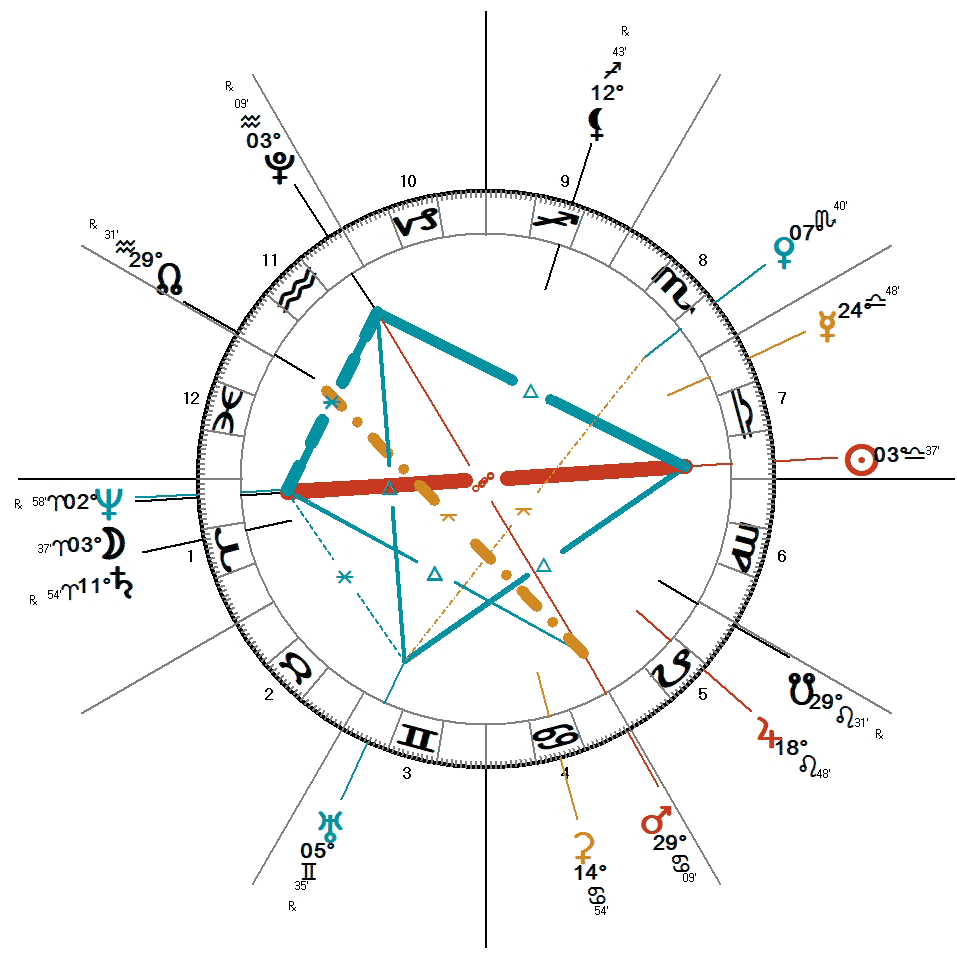
In the sprawling ecosystem of contemporary digital culture, specialized online archives serve as vital hubs for practitioners, researchers, and enthusiasts of esoteric arts. Among these, platforms dedicated to astrometeorology, traditional chart interpretation, and fixed-star astrology have carved out significant digital footprints. One notable node in this network is Darkstar Astrology, a resource that catalogs planetary alignments, astrological decans, and the mythological underpinnings of the night sky.
The core subject matter of such platforms revolves around the ancient practice of interpreting celestial phenomena—not merely through the lens of modern psychological sun-sign horoscopes, but via traditional methodologies that incorporate fixed stars, planetary hours, and mundane astrology. While the scientific community categorically dismisses astrology as a pseudoscience lacking empirical validation, cultural and sociological studies consistently reveal a resilient, multi-million-dollar global interest in these practices.
At the center of this ongoing cultural phenomenon is a fundamental tension: the immutable laws of astrophysics versus the deeply human desire for narrative, meaning, and temporal synchronization. Digital repositories function not only as instructional guides for chart calculation but also as modern digital sanctuaries where ancient belief systems adapt to the hyper-connected realities of the twenty-first century.
Chronology
To understand how traditional astrology has transitioned from ancient Babylonian clay tablets to contemporary websites, it is necessary to examine the historical milestones that shaped the field:
- c. 2000 BCE – 500 BCE: Early Mesopotamian astronomers meticulously map the movements of celestial bodies, primarily for mundane purposes such as predicting weather patterns, agricultural yields, and the fates of monarchs. The division of the zodiac into twelve signs takes root during this period.
- c. 2nd Century CE: The Greco-Egyptian writer Claudius Ptolemy compiles the Tetrabiblos, a comprehensive treatise that standardizes astrological theory, blending Aristotelian physics with Hellenistic predictive techniques. This text becomes the foundational blueprint for Western astrology for over a millennium.
- 17th Century: The Scientific Revolution, marked by the heliocentric models of Copernicus and Galileo and the gravitational laws of Isaac Newton, systematically separates astronomy from astrology. Astrology is gradually expelled from European universities, retreating into private practice and esoteric societies.
- Late 19th to Mid-20th Century: The occult revival, spearheaded by figures such as Alan Leo, popularizes modern psychological astrology. The introduction of accessible ephemerides allows amateur practitioners to cast charts without complex manual calculations.
- Late 20th Century: The advent of personal computing introduces software capable of instant chart generation. Astrological content migrates from printed gazettes and newspaper columns to early internet bulletin boards and specialized web domains.
- 21st Century: The digital age democratizes astrological knowledge further. Websites, social media platforms, and specialized databases create global communities. Platforms emerge to archive specialized branches of the craft—such as fixed-star interpretations—making esoteric knowledge instantly searchable to anyone with an internet connection.
Supporting Data
While traditional science views astrology through the prism of statistical impossibility, demographic and economic data underscore its persistent cultural footprint:
- Market Valuation: The global spiritual and metaphysical services market—which encompasses astrology, tarot reading, meditation apps, and crystal healing—was valued at over $2.2 billion globally by market research analysts in the early 2020s, with digital platforms driving a significant share of the growth.
- Demographic Shift: According to various cultural surveys conducted over the past decade, interest in astrology is disproportionately high among Millennials and Generation Z. Sociologists attribute this trend to economic uncertainty, a decline in traditional institutional religion, and a broader cultural turn toward holistic self-care.
- Digital Engagement: Search engine analytics reveal millions of monthly queries related to natal charts, retrograde periods, and planetary transits. Specialized niche sites dedicated to advanced astrological techniques—such as fixed-star conjunctions—attract dedicated cohorts of amateur researchers who spend hours cross-referencing historical ephemerides.
- Scientific Consensus: Double-blind studies, most notably the landmark 1985 study by physicist Shawn Carlson published in the journal Nature, have consistently failed to demonstrate any statistical correlation between astrological predictions and real-world outcomes beyond random chance.
Official Responses
The coexistence of ancient belief systems and modern empirical science elicits distinct responses from the academic, scientific, and esoteric communities:
The Scientific Perspective
Mainstream scientists and skeptics maintain a unified stance regarding astrology. Organizations such as the National Science Foundation (NSF) and various national committees for scientific inquiry classify astrology as a quintessential pseudoscience.
"Astrology relies on confirmation bias, the Barnum effect, and vague generalities that allow individuals to project their own desires and experiences onto arbitrary celestial configurations," notes Dr. Elizabeth Vance, a professor of science communication at a major research university. "While the human mind is exceptionally gifted at finding patterns, empirical validation requires reproducible, double-blind methodologies—standards that astrology has never met."
The Practitioner Perspective
Conversely, modern astrologers and archive curators argue that measuring astrology with the tools of reductionist science is a category error. They contend that astrology was never intended to be a physical science in the modern sense, but rather a symbolic language, a phenomenological framework, or a tool for psychological introspection and timing.
"We do not look at specialized databases or traditional charts expecting a clockwork mechanism of physical causation," explains Marcus Vance, a professional astrologer and historical researcher. "Instead, we view the cosmos as a macrocosmic clock. The alignments do not cause events in a deterministic vacuum; rather, they reflect qualitative shifts in time. It is an art of correlation and hermeneutics, not Newtonian physics."
Implications
The enduring popularity of astrology in the digital age carries profound implications for modern psychology, media consumption, and the philosophy of science.
Psychological and Therapeutic Dimensions
From a psychological standpoint, the utilization of astrological archives and natal chart analysis often functions as a structured form of narrative therapy. Carl Jung famously explored astrology as a projection of unconscious archetypes. When individuals engage with complex astrological systems—interpreting how distant stars interact with their psychological profile—they are essentially engaging in a rigorous exercise of self-reflection. The archetypal language provides a safe, externalized framework through which individuals can process trauma, understand behavioral patterns, and construct a coherent personal narrative.
The Erosion of Epistemic Authority
The accessibility of esoteric knowledge via specialized websites also highlights a broader shift in how society relates to institutional expertise. In an era marked by skepticism toward traditional authorities—ranging from mainstream journalism to academic institutions—individuals increasingly curate their own worldviews by synthesizing science, psychology, and alternative spiritualities. While this democratization of information empowers individuals to explore diverse philosophical traditions, it also blurs the lines between empirical fact and subjective belief, posing ongoing challenges for science communicators and educators.
Preservation of Esoteric Heritage
On a cultural level, digital archives dedicated to niche subjects—such as the astrological influence of fixed stars like Aldebaran, Regulus, or Algol—act as digital museums for ancient lore. Long after the original practitioners have faded, these databases preserve historical texts, translation commentaries, and esoteric methodologies that might otherwise be lost to time. Whether viewed as historical anthropology or living practice, these repositories ensure that humanity’s earliest attempts to map meaning onto the cosmos remain accessible for future generations to study, analyze, and debate.