









ISTANBUL, TÜRKİYE — In an era dominated by rapid automated manufacturing, algorithmic design trends, and flat-packed disposability, a quiet counter-movement is taking shape in workshops across Türkiye. Regen Studio, a boutique design practice and furniture maker, represents a deliberate step away from mass production and toward a philosophy of permanence. Operating at the intersection of architecture, traditional handcraft, and contemporary sculpture, the studio creates bespoke, made-to-order furniture that treats domestic space not merely as a container for objects, but as a living, breathing ecosystem of form, texture, and mood.
Main Facts: The Anatomy of Regen Studio
At its core, Regen Studio is defined by a commitment to architectural rigor and artisanal execution. Rather than operating as a conventional furniture brand driven by seasonal catalogs, Regen functions as an independent design laboratory where every piece is fabricated individually upon order.
- Founding & Location: Based in Türkiye, the studio is spearheaded by a trained architect who translates spatial concepts into tangible interior elements.
- Production Model: Zero mass scaling. Every item is produced by hand in collaboration with skilled local artisans, ensuring that no two pieces are entirely identical.
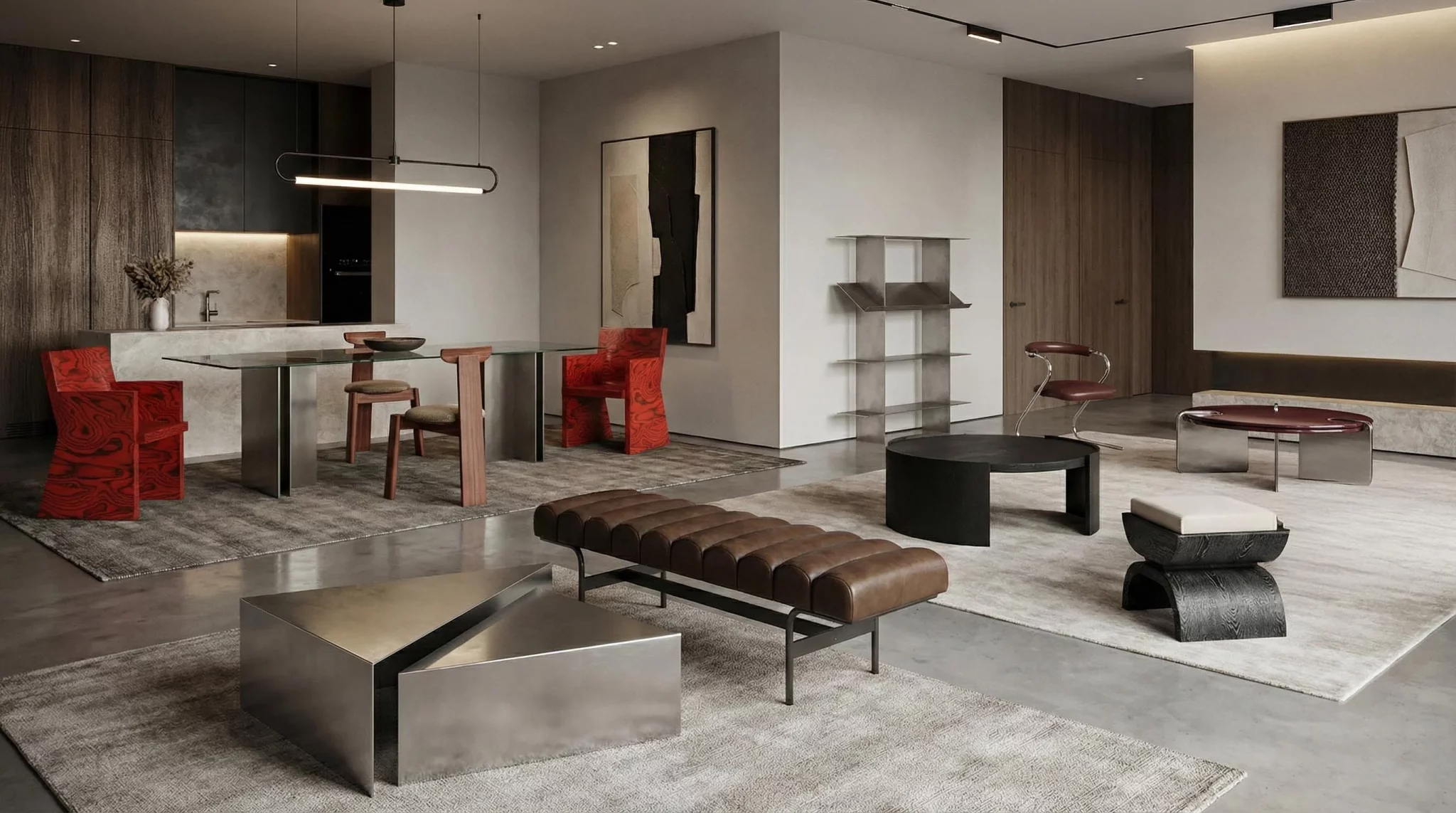
- Design Philosophy: A fusion of mid-eastern and mid-century modern sensibilities, heavily reliant on architectural proportions, historical techniques, and the elevation of forgotten materials.
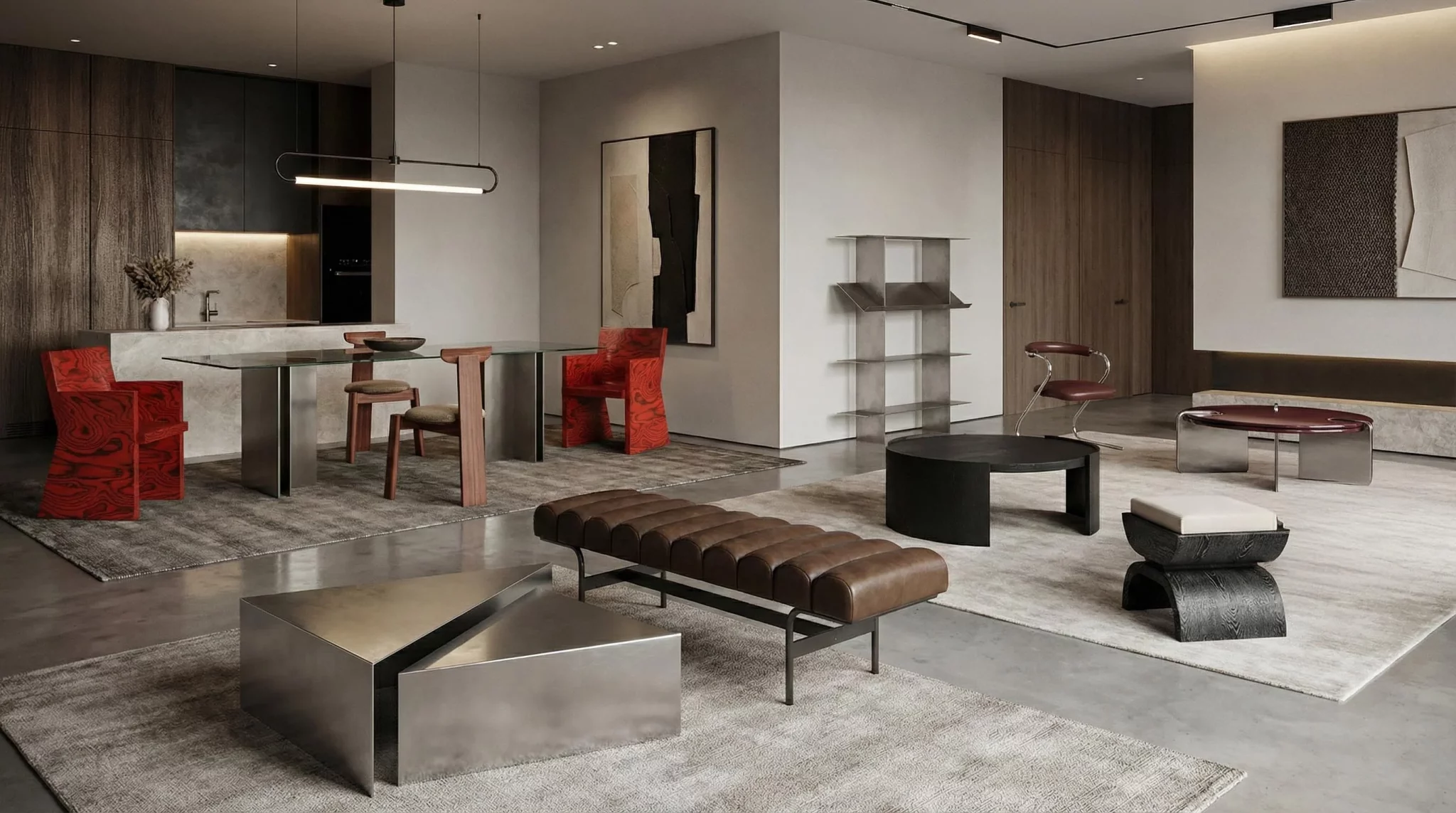
- Signature Offering: The Kira Chair—a striking, root-veneer and wood construction featuring a bold red polish and meticulous architectural proportions (88 × 56 × 63 cm).
- Fulfillment: Made-to-order craftsmanship with an international delivery window of two to four weeks.
Chronology: From Spatial Problem-Solving to an Independent Practice
The evolution of Regen Studio follows an organic trajectory, born not from a strategic corporate launch, but from the cumulative repetition of creative solutions within architectural assignments.
Phase One: The Architectural Genesis
Years before Regen Studio existed as an autonomous brand, its founder worked primarily as an architect. In the course of designing physical spaces for private clients, spatial challenges routinely arose—awkward corners, specific lighting requirements, or the need for functional statements that simply could not be sourced from commercial suppliers. To solve these localized design problems, the founder began designing custom furniture and architectural elements tailored explicitly to those environments.
Phase Two: The Recognition of a Shared Logic
Over time, a pattern emerged across these disparate projects. Despite the varying briefs and spatial contexts, a distinct visual and structural language kept reappearing. The same sensitivity toward proportion, the same philosophy of material weight, and the same instinct for how an object should command or soften a room were present in every custom piece. This continuity became impossible to ignore. The furniture was no longer just filling spaces; it was dictating them.

Phase Three: Autonomy and the Birth of Regen
Driven by the desire to explore this design language free from the constraints of client briefs and commercial compromises, the founder formalized the practice. Regen Studio was established to give an independent structure to this creative philosophy. The studio shifted its focus from servicing specific architectural sites to creating standalone collectible objects that carry their own spatial logic, marking the official transition from architectural firm to bespoke furniture brand.
Supporting Data & The Maker’s Mindset
To understand Regen Studio, one must understand the mind of an architect. In the studio’s ecosystem, furniture is never treated as an isolated accessory; it is viewed as an extension of the building itself. Proportion, spatial relationships, and the capacity of an object to hold or release the atmospheric tension of a room are architectural problems. Regen simply answers them using wood, metal, color, and tactile finishes.
Bridging Eras: Mid-Century Modernism Meets Forgotten Techniques
The studio’s aesthetic draws heavily from the mid-century modern movement—celebrating organic forms, functional clarity, and an honest appreciation for raw materials. However, Regen refuses to indulge in uninspired retro revivalism. Instead, the practice mines the past for forgotten techniques and marginalized materials that industrial manufacturing cast aside for the sake of speed and cost efficiency.
By taking these historical methodologies and reinterpreting them through a contemporary design vocabulary, Regen establishes a dialogue between epochs. The past and the present do not compete in their pieces; they converse.
The Iterative Process and the Power of Constraint
Every Regen object begins with context. Before a single line is drawn or a material is selected, the studio asks foundational questions: How will this piece inhabit a space? What emotional and atmospheric support should it provide?

Once the architectural parameters are established, the process transitions into material exploration. Textures, finishes, and combinations are tested to ensure the object achieves a delicate balance between physical presence and spatial subtlety. This is an iterative cycle of drawing, making, and refining. Collaboration with the workshop is integrated from day one, ensuring that craftsmanship actively shapes the character of the piece rather than serving as a superficial finishing touch.
Crucially, Regen embraces constraints as creative catalysts. Many of the studio’s most innovative designs initially emerged under severe real-world pressures—tight timelines, spatial limitations, and material scarcities encountered during architectural builds. Rather than viewing these limitations as obstacles, the studio treats them as essential parameters that demand higher precision, resulting in more thoughtful and exact design solutions.
The Object: Analyzing the Kira Chair
To witness Regen Studio’s philosophy distilled into a single physical form, one need look no further than the Kira Chair.
Constructed from a rich root veneer and wood framework, the Kira Chair commands attention through quiet confidence rather than aggressive loudness. Finished in a bold, striking red polish, the chair possesses a sculptural quality that anchors a room without overwhelming it. At dimensions of 88 × 56 × 63 cm, its proportions are derived from architectural scaling—designed explicitly for the human body within a room, rather than optimized for flat-pack shipping or a digital catalog.
The chair is fully customisable, with polish colors adaptable to the specific interior palette of the client. Handcrafted by local Turkish artisans upon order, the Kira Chair functions less as a utilitarian seat and more as what the studio describes as a "mirror of the person who lives with it"—a piece designed to age alongside its owner and quietly dictate the atmosphere of its environment.

Product Specification Summary:
- Item: Kira Chair
- Maker: Regen Studio
- Materials: Root veneer, high-grade wood veneer construction, custom polish
- Dimensions: 88 cm (H) × 56 cm (W) × 63 cm (D)
- Customization: Fully customizable polish colors available upon request
- Production: Handcrafted to order in Türkiye by local artisans
- Lead Time / Delivery: 2 to 4 weeks worldwide
Implications: The Future of Collectible Craft in Contemporary Design
The rise of ateliers like Regen Studio points toward a broader, shifting paradigm in high-end interior architecture. As consumers and designers grow increasingly fatigued by hyper-globalized, homogenized furniture markets, there is a palpable resurgence in demand for hyper-local, transparently sourced, and soul-infused craftsmanship.
By anchoring furniture design in architectural principles, Regen proves that objects can possess structural integrity while serving as emotional anchors. The studio’s success suggests a viable economic and creative model for modern artisans: one that bypasses industrial scaling in favor of longevity, refuses to sacrifice heritage techniques for modern convenience, and treats the domestic interior not as a showroom, but as an intimate gallery of human habitation.
In a world rushing toward the virtual and the mass-produced, Regen Studio offers a heavy, tactile reminder of what it means to make things once, make them well, and make them to last.